resources

Making your message work for everyone

There is a well known Indian folk story that describes how a group of blind men who encounter an elephant all have very different descriptions based on their individual experience of the parts, rather than the whole. When we communicate, it is important to break down ‘the elephant’ into the parts that make the most sense to the most people.

The 4C Communication test ensures that your messages are clear enough to describe the whole to four very different people.
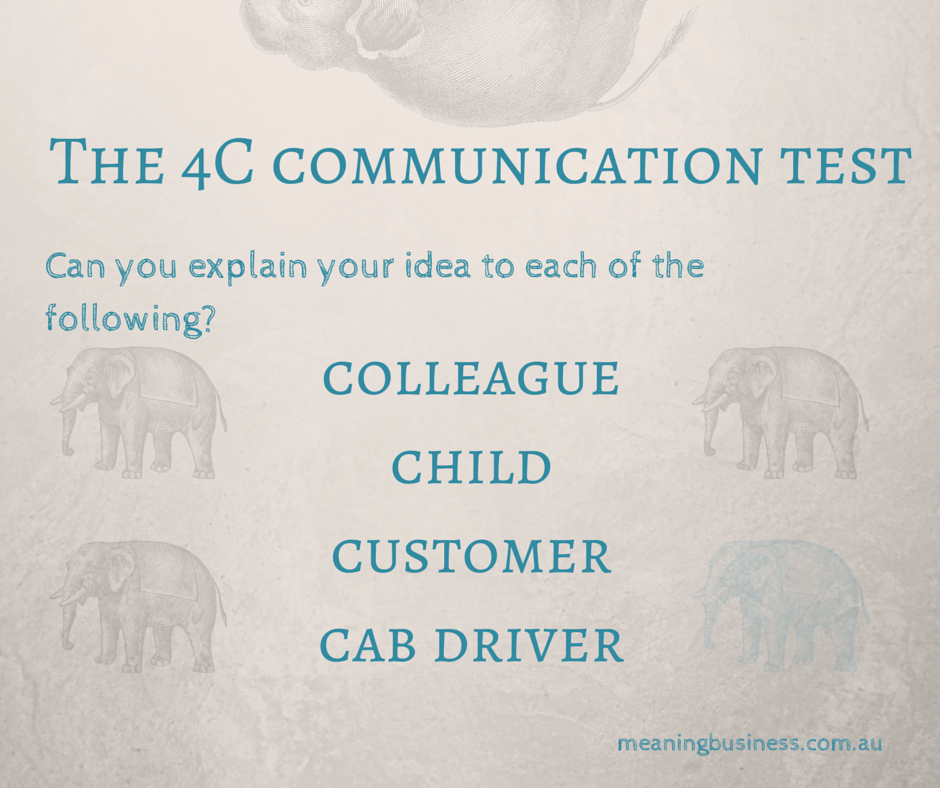
4C Communication Test

  • A colleague: This tests clarity and depth of understanding. It is the ‘fact check’ version of a message. A colleague will be able to understand the concepts and the detail of the message. Framing your message for a colleague tests for credibility.
  • A child: This forces us to use the most essential elements to create a simple message. Simultaneously conceptual and concrete, the ‘for a child’ test is a challenge of eliminating all but the core. Framing your message for a child tests simplicity.
  • A customer: This message test asks us to focus on the ‘so what’ of a message and to consider the relevance to the ‘other’. How does this help me? Why should I care? Framing your message for a customer tests relevance.
  • A cab driver: Be prepared to explain yourself and to hear a counter-perspective*. Does your message stand up to the scrutiny of a stranger? Framing your message for a cab driver tests for opposition.

There are other variations of this. Consider the personas that would be useful tests in your environment.

*In no way am I suggesting that cab drivers are essentially argumentative. However, my unscientific sampling spread over many years would indicate that many are conversationalists who have a sense of public opinion, often based on talk radio. 
Get the foundations right for 2015

How many times have you heard “I can’t believe it is December already!” from colleagues or family lately?

The end of the calendar year provokes responses ranging from shock at the speed of time passing, through to satisfaction at the achievements of the year, to mild panic as people look to their plans for 2014 and realise what is missing.

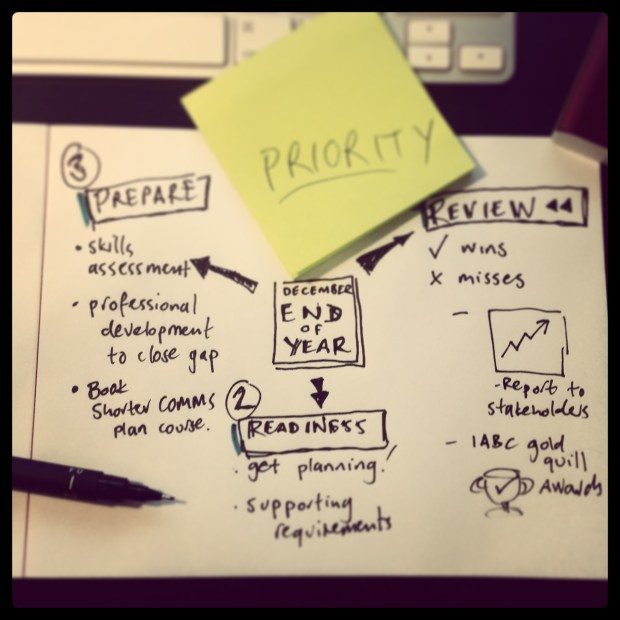
For communicators, December is a time to be able to reflect on the achievements of the waning year, while setting up for success in 2015.

Capture knowledge from the year

  • Take time to capture the lessons, issues and achievements of the year. If you already have a reporting process, pull out the highlights.
  • If communication projects didn’t have a formal post-implementation review, take time to capture successes and the areas that needed improvement.
  • Consider an annual ‘communication report’ to key stakeholders.
  • Consider whether to seek recognition for quality work. The IABC Gold Quills are open for entries until 7 January.*

Plan for the year ahead

  • Understand the priorities for the businesses, teams and clients you support for 2015.
  • If they do not have clear plans yet, use the opportunity to schedule communication planning sessions with your key stakeholders.
  • Determine how to address any gaps or improvements from past communication projects.

Prepare yourself

  • Take time to assess your capabilities based on what was achieved and what will happen in the year ahead.
  • Plan development options such as participating in professional associations, seeking coaching or undertaking skills training to fill any gaps.

Keeping plans simple

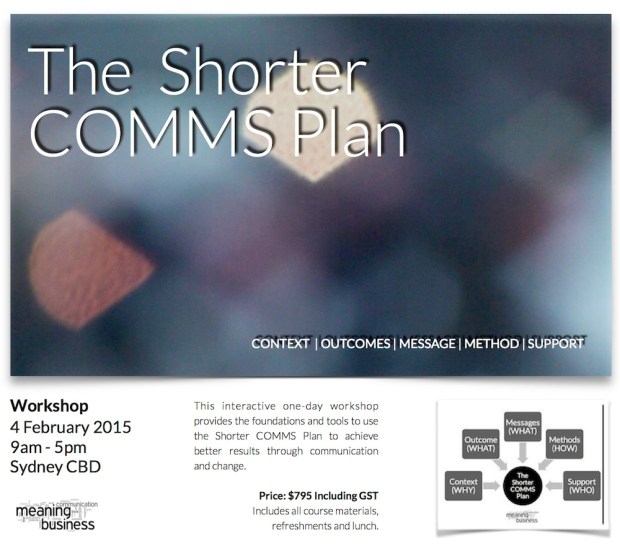
The pace of change in organisations requires us to be adaptive. Plans change, often. Focus on tools and processes that enable flexibility, that are simple to use. Using a common approach across your organisation builds skill and consistency. The Shorter COMMS Plan is a simple methodology to support better outcomes from all types of communication; whether small projects, business planning or team management. A new one-day workshop designed to help apply the Shorter COMMS Plan is being held in Sydney on 4 February.

New Workshop to apply the Shorter COMMS Plan is now available.

New Workshop to apply the Shorter COMMS Plan is now available.


* Disclosure: I am Co-Chair of the Gold Quill Blue Ribbon Panel for Asia Pacific.


New change management presentation added to the library

The Meaning Business Presentations page has a few new additions, including the PRIA webinar on change, and a super short guide to the Shorter COMMS Plan.

Help employees tell their stories with simple tools

The Universe is made of stories, not of

Crowdsourcing is a growing feature of organisational communication; but it is not entirely new. In near-bygone times of the employee newsletter, stories sourced from the frontline were a staple form of content. People like to hear what people like them have done. In particular, people like to hear how people like them have solved a problem, achieved a goal or overcome a challenge. These stories are the lifeblood of organisational life.

As digital communication expands the ability to capture and share stories, it is important to give employees tools and resources to help make their sharing effective. In particular, understanding the basic nuts and bolts of what makes a story a story is a useful reminder.

The four Ps – people, place, plot and purpose

This short video from the clever folk at StillMotion provides a beautifully simple model for helping people shape their information in a way that tells a story.


Once…then…then…

There are many tools that help people listen for, capture and shape stories. Various sentence structures provide ways of outlining the context, the characters and the challenge. Perhaps the simplest of these is the Pixar model (adapted from a range of sources)

Once there was a ___. Every day, ___. One day ___. Because of that, ___. Because of that, ___. Until finally ___.

There is always more than one perspective

Organisations are microcosms of the rest of the world. In the world there are millions of stories that overlap, different experiences of the same event. Any story-work within organisations or communities needs to recognise this diversity of experience.  This TED talk from novelist Chimamanda Adichie is a compelling example of how multiple stories shape our existence.

It is impossible to talk about the single story without talking about power. There is a word, an Igbo word,that I think about whenever I think about the power structures of the world, and it is “nkali.” It’s a noun that loosely translates to “to be greater than another.” Like our economic and political worlds, stories too are defined by the principle of nkali: How they are told, who tells them, when they’re told, how many stories are told, are really dependent on power.
– Chimamanda Adichie

The idea of managing multiple stories in the organisation is at the heart of my work on ‘strategic story worlds

Keep it human

There is an abundance of material on storytelling available on the web. It is important to come back to the basics before embarking on any formal storytelling activities.

We are human, we are already hardwired to use story as our means of making sense of the world. By being conscious of this as a start point, it is possible to ensure ‘storytelling’ in organisations is not a trend or just a process to be followed to get people ‘on the same page’ but is instead a fundamental part of the sense-making capability of an organisation and its people.