How can communicators use the transition from current COVID-19 circumstances as a way of thinking about what is holding us back and what is possible for the next phase of communication in our organisations?
We continue to be living and working in unprecedented times. As part of the recent round of IABC APAC Region meetups during COVID-19, and in working with clients and colleagues in Australia, in the region and globally, I am acutely aware of my fortune. As countries move through their national stages of pandemic response (and other significant challenges) I’ve listened to stories and experiences of other communication and change professionals.
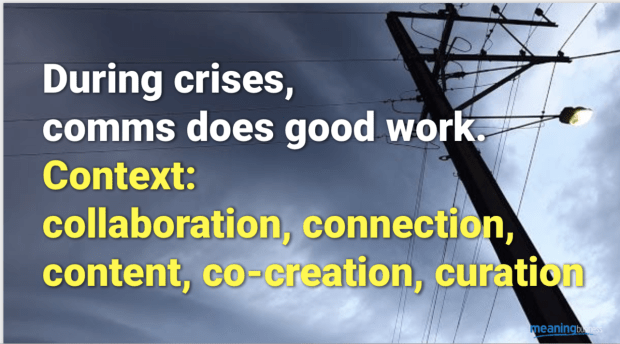
My personal belief is that it’s not the right time to be making hard or universal predictions on what’s next. Instead, here’s a framing tool to consider what to keep and what to leave behind. It’s an exercise I’ve used in other settings and it’s got great potential for asking ourselves and our organisations two questions as we move to whatever ‘next’ is. In this 16 minute discussion, I look at why there is no ‘new normal’, at how communicators can use this time as a way of making choices about their practice and in how that same approach can apply to the communication industry more broadly. I’d love to know your thoughts and to continue the conversation.
How to decide what to keep and what to let go of as we move to the next phase of COVID-19
A three-part series on communication actions organisations can take now during the response and recovery phases of the Australian fire catastrophe.
The essentials:
As those workplaces that closed over Christmas and New Year reopen after the break, a few simple internal communication actions will help both the operational and human responses to the current Australian fire catastrophe. The most effective employee communication responses will:
Acknowledge clearly any known employee, supplier and customer impacts.
Provide up to date operational and policy information, commit to an ongoing process and provide a ‘single source of truth’ for information.
Allow for a human response to the situation, and provide resources. For many, this was not a typical break – expect this to be a talking point.
Incorporate a feedback channel, along with a process for asking questions and providing prompt consistent responses.
Proactively and clearly share any policies and processes for volunteer leave, employees impacted by travel or health arrangements (for example smoke), requests for group fundraising, matched donations or other community engagement.
Recognise that the scale of the situation means that even people not directly impacted may have family or friends who were.
Reinforce the key requests of organisations for donations or support activities (such as encouraging fundraising over donation of goods unless directly sought by an organisation – work with the peak bodies for this).
The long version:
While a great many businesses remain open throughout the Christmas holidays, this is still the peak holiday time for many Australians. The 6th of January will see many people returning to work for the first time since the Christmas break, and will be the first time that many people are coming back into the workplace. It has been an extraordinary summer due to the extended fire emergency across States within Australia, and workplaces will need to take some measures to communicate about this.
Many large organisations, particularly those with workforces in areas affected will already have had to enact business continuity plans over the Christmas break due to some of the disruptions caused by the emergency, either for customers, or suppliers or employees impacted. Banks, telcos and utilities have already communicated with employees and customers.
And many communications teams would have been operational over the break ensuring that employees are kept up to date about operational risks and customer or client impacts. Some organisations also have employees who are volunteers in some capacity and so will have already been managing this. Many businesses have been managing communication as the need has arisen over the past 100 days of fires, but the scale and nature of the impacts over the past weeks have made an impact on all Australians.
What to do…
For those organisations who have not yet had to manage any direct impacts, there are some key things to manage and communicate with employees as they resume operations this week.
Context
The scale and nature of the events of the past few weeks mean that many people have either first-hand experience of the impacts of the fires or directly know someone who has.
Has your organisation been directly impacted?
Is your organisation doing things specifically to support the response or recovery?
Do you have employees who have been directly affected?
How does your organisation already communicate about issues and emergencies?
Are roles clear and information consistent already, and if not, how will this be done?
These questions will inform what actions are required as well as who within the organisation will need to be involved prior to communication.
Outcomes
Even in response to a crisis, it’s essential to be clear of the outcomes of your communication activities. Three outcomes that would be helpful at this time are:
Build or strengthen capability.Increase readiness for any escalation or additional impacts by using/reinforcing your effective catastrophe or crisis communication approaches.The best time to have a plan in place is before you need it, but this is an opportunity to build the capability as it is required.
Effective, simple operational information. Whether it’s simply providing information about Volunteering Leave and Health and Safety or detailed information on things your business or organisation is doing to support or in response to the impacts of the fires.
Recognise and incorporate employee response.Being prepared for an understandable range of reactions to the situation and incorporating opportunities for involvement, discussion and support will reduce confusion, concern and allow employees to have their needs addressed.
Messages
Each organisation will have different specific messages according to the context, the industry, the geography and a range of other factors, but these are essential:
Acknowledgement that this has been an exceptional time – even if the organisation is not directly impacted.
What, if any, are the impacts?
What does this mean for today and the short term?
What help is available to employees and customers.
Specific proactive information about leave, employee support, process or customer changes.
Commit to providing ongoing regular information and provide any updates promptly.
If your organisation is impacted, face to face or video stream is a preferred way of consistently getting the initial messages across, backed up by the other effective channels* in your organisation.
Use your most effective channels for push messages. If yours is an email organisation, use that. It may be a messaging platform, text or digital signage.
Have a single source of information. Whether you use an intranet, shared drives, internal social media, or a notice board in the break room, choose one place as the single source for information and keep it current.
If your organisation has internal social media such as slack, yammer, or workplace consider using two dedicated threads or hashtags: one for operational information, policy, process and questions, and; one for general discussion. Doing so allows for a single source of essentials while factoring in the reality of how people are likely to interact.
* It helps to know what channels work within your organisation ahead of a crisis. There is not a magic formula for this as there are significant differences according to size, nature of work, nature of industry, nature of the workforce. Contact the author for more on this.
Support
To support this consistent approach:
Delay non-essential communication. People will not have the bandwidth this week.
Provide extra time and resources to ensure managers can have face time with their direct reports.
Schedule a talk time. This could be combined with a fundraising activity or more organic. Depending on the size of your organisation, it might be possible for everyone to gather, or it might be of a scale where teams need to meet individually.
Provide Employee Assistance Program links.
Empower teams to determine how and where support, volunteering or fundraising is offered. Everyone is different and while crisis brings a strong sense of community, there will be different ideas about how and who to support. Factor this into any organisational arrangements early and allow for choice.
Lastly, this week is also not the time for overt promotion of the organisation’s efforts. Do the things that matter. Communicate regularly and factually. Provide opportunities for people to talk informally and let that flow into constructive contribution.
This is the first in a series of posts to help organisations communicate effectively during the response and recovery phases of this catastrophe. The next post will include more detailed steps for organisations that don’t have a communication team, and the final post will cover ways for communication and leadership teams to manage the ongoing and future situations.
For additional information or support, please get in touch.
Jonathan Champ SCMP is a communication advisor with 25 years experience across a range of sectors. He is the founder of Meaning Business and creator of the COMMS planning method.
Thanks to Craig Spencer, General Manager Strategy and Performance at Royal Flying Doctor Service (WA) and Jenni Field, Director Redefining Communication for their contribution to the development of this article.
It’s comms conference season, and that means the internet will be abuzz with 140 character insights from a range of events.
There are exciting – and challenging – emerging trends and new insights. We will see that in abundance at the excellent #IABC16 this week as the worlds leading communication membership association gathers around the theme of innovating global communication.
When you have been fortunate to have attended, chaired, co-curated and presented at a fair range of communication conferences and events*, you do start to see patterns in terms of insights and learnings. These recurring insights form a kind of communicators BINGO!
#commsbingo
If we are to judge the progress of our profession by the wisdom shared on twitter from many comms events, then it seems we are caught in a loop. Yes, communication events do attract emerging practitioners. But seeing foundation knowledge shared as revelations does raise some questions about how effectively we are preparing communicators for professional practice.
If we are to continue to develop, to grow our collective commons and body of knowledge, we need to keep pushing for deeper insights, evolve our discussions and move beyond the foundations through research, education and creating connection.
Oh, and if you have any other #commsbingo insights, please tweet them so we can collate the common knowledge.
Share well!
*I have been a past chair and co-curator of Melcrum Strategic Communication & Digital Communication Summits in Asia Pacific, presented at the 2014 IABC WC in Toronto, and have been involved in communication professional development since before twitter was invented. Learn more about the Shorter COMMS Plan in thisfree webinar.
How many times have you heard “I can’t believe it is December already!” from colleagues or family lately?
The end of the calendar year provokes responses ranging from shock at the speed of time passing, through to satisfaction at the achievements of the year, to mild panic as people look to their plans for 2014 and realise what is missing.
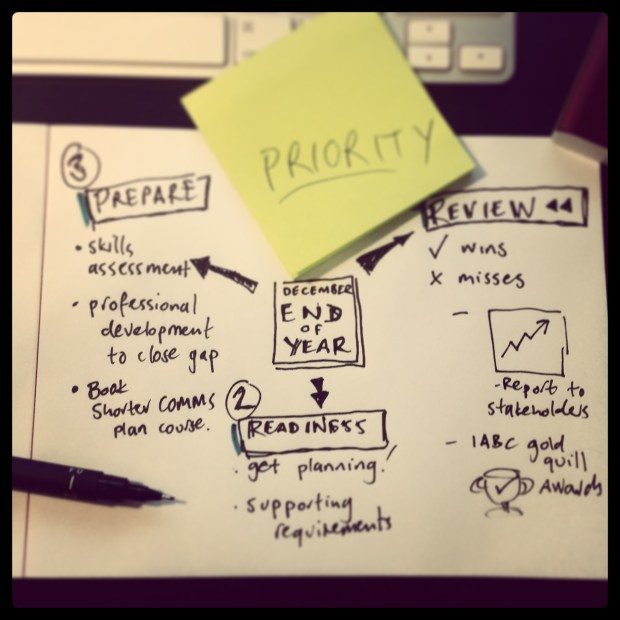
For communicators, December is a time to be able to reflect on the achievements of the waning year, while setting up for success in 2015.
Capture knowledge from the year
Take time to capture the lessons, issues and achievements of the year. If you already have a reporting process, pull out the highlights.
If communication projects didn’t have a formal post-implementation review, take time to capture successes and the areas that needed improvement.
Consider an annual ‘communication report’ to key stakeholders.
Consider whether to seek recognition for quality work. The IABC Gold Quills are open for entries until 7 January.*
Plan for the year ahead
Understand the priorities for the businesses, teams and clients you support for 2015.
If they do not have clear plans yet, use the opportunity to schedule communication planning sessions with your key stakeholders.
Determine how to address any gaps or improvements from past communication projects.
Prepare yourself
Take time to assess your capabilities based on what was achieved and what will happen in the year ahead.
Plan development options such as participating in professional associations, seeking coaching or undertaking skills training to fill any gaps.
Keeping plans simple
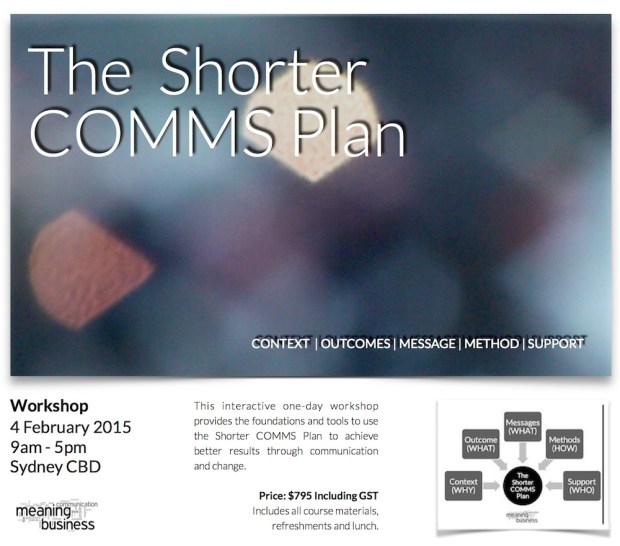
The pace of change in organisations requires us to be adaptive. Plans change, often. Focus on tools and processes that enable flexibility, that are simple to use. Using a common approach across your organisation builds skill and consistency. The Shorter COMMS Plan is a simple methodology to support better outcomes from all types of communication; whether small projects, business planning or team management. A new one-day workshop designed to help apply the Shorter COMMS Plan is being held in Sydney on 4 February.
New Workshop to apply the Shorter COMMS Plan is now available.
* Disclosure: I am Co-Chair of the Gold Quill Blue Ribbon Panel for Asia Pacific.



 Meaning Business