Thanks to all the wonderful clients, collaborators, partners, and communicators for a wonderful year in 2018. Meaning Business will be taking a little break from 20 December until 2 January. See you next year.

Thanks to all the wonderful clients, collaborators, partners, and communicators for a wonderful year in 2018. Meaning Business will be taking a little break from 20 December until 2 January. See you next year.
Earlier this year I was working with a Head of Communications in a government agency that has undergone significant structural transformation and operational change over the past two years.
She was working on deepening the engagement between leaders and employees in different areas and had asked for some advice on how to ensure communication was flowing two ways. I asked, “What business as usual channels do you rely on today?”
“We don’t use the term BAU any longer. Transformation is going to continue. Change is business as usual and we now adopt a continuous improvement approach” she said.
It was a moment of absolute clarity for me. How many of us think of ‘BAU’ communication as distinct from the projects and initiatives that come through the door, or into the inbox.
As part of the IC Kollectif IC In 2017 Project, I had some thoughts at the start of the year about how communicators can work with other areas to learn, innovate and adapt. But this realisation, half way through the year, made me consider what communicators can do in times of perpetual change, not just to service their organisations, but to ready themselves for ‘no more BAU’.
Read my full response on the IC Kollectif IC In 2017 Project.
What does a great day in the office or the field look like?
When did your communication activity lead to an outcome that furthered the organisation, the employees and the leaders? Creating connection, improving performance, perhaps just a moment of insight quoted back to you. Share what your ‘great day in the office’ looks like below.

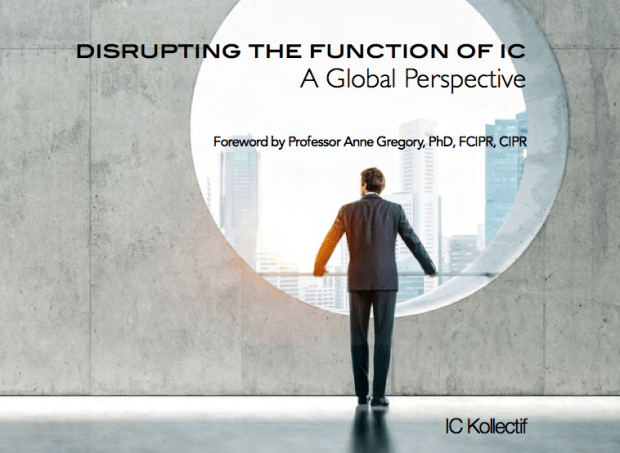
IC Kollectif has launched a unique addition to the internal communication canon. The ebook, Disrupting the Function of IC, A Global Perspective featuring contributions from 30 global internal communication leaders.
What is impressive is the degree to which editor Lise Michaud has facilitated diversity in the conversation about practice. This is truly a global communication guide. With voluntary contributors from every region, the guide has captured the differences in the current state of how practitioners need to respond to their organisations.
Diversity brings difference, and a particularly exciting aspect of the project is the range of different opinions. There are few places (outside Twitter) where there is such representation of views and practices that span all the IC practitioner tribes; IABC, Global Alliance, CIPR amongst others.
There are divergent views on how to approach the ongoing symbiosis between IC and technology, on engagement, on the most important skills and the biggest challenges. Communication and communications.
Some of the common themes include:
I feel privileged to be in the same company as the other contributors and applaud all the authors for bringing current and new thinking to one place.
Let the conversations begin!
The 222 page ebook can be downloaded from IC Kollectif (free subscription required for download).
http://www.ickollectif.com/single-post/2017/06/11/Disrupting-the-Function-of-IC—A-Global-Perspective
Everyone is a storyteller. Because we are human. We tell our friends and families what happened at work. We tell our colleagues what happened on the way to work. We tell stories.
And we make sense through stories. We are hardwired for it.
But not everyone is a natural Storyteller.
Here are three resources that start to help identify and shape the stories you encounter in organisations.
Once. Then. Then. The story spine.
A couple of years ago, Pixar’s 22 rules for storytelling

The story spine, Kenn Adams’ definition has been used by Pixar and Disney.
The Moth’s 8 Tips
The Moth is a not-for-profit foundation committed to the development of art and craft of storytelling. Amongst their many resources for improving oral storytelling, including videos and podcasts, they have a simple list of 8 tips. These include:
Stakes are essential in live storytelling. What do you stand to gain or lose? Why is what happens in the story important to you? If you can’t answer this, then think of a different story. A story without stakes is an essay and is best experienced on the page, not the stage.
Anecdote’s Spotting Oral Stories Infographic
The clever folk at Anecdote have created a useful guide to recognising stories within an organisation.
The following graphic has been created by http://www.anecdote.com

 Meaning Business