socialmedia

Social Media Club Fail and the perils of scheduled tweets #SMClub

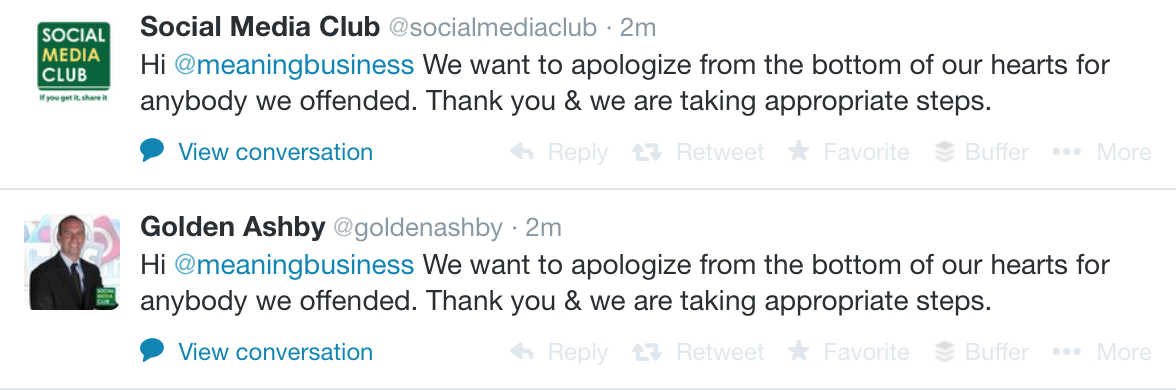
Update: Following the publication of my article, there was formal contact from Social Media Club apologising for the post and acknowledging that appropriate action would be taken, and the original post by Audrey Rochas has been removed from their site

12 hours after the original contact, Social Media Club have apologised and removed the original post by Audrey Rochas

12 hours after the original contact, Social Media Club have apologised and removed the original post by Audrey Rochas


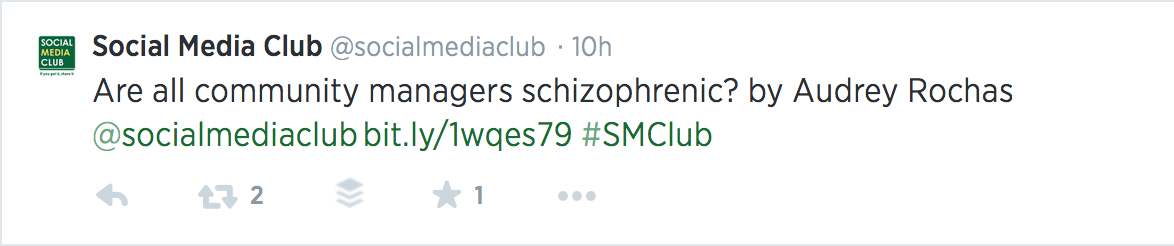
Earlier today, the scheduled tweets of the Social Media Club, a loosely organised social media promotion organisation, posted the following tweet:
The offending tweet from @socialmediaclub

The offending tweet from @socialmediaclub

As a communicator, I am interested in community management, effective use of social tools such as Twitter to build awareness and drive engagement.

As a human, I am also interested in social good, including mental health. I have family members who have experienced a range of long and short term mental illnesses, have lost extended family and friends to suicide and my partner works in mental health education. It’s kind of a vested interest, and as such I care about representations of mental illness online, in the arts and in the workplace.

So my ire was already rising when I clicked through to the article, which perpetuates the ‘mutiple personality’ myth of schizophenia throughout. Most offensive however, was the accompanying image of the ‘angel and demon’.

The offending imagery attached to Social Media Club post

The offending imagery attached to Social Media Club post

There is a long history of equating mad with bad, which goes a long way to contributing to the lack of awareness of mental illness, the perpetuation of outdated knowledge and stereotypes.

Am I overreacting? Considering Social Media Club positions itself as an organisation that promotes good online practices, and has over 150,000 followers on Twitter, and 42000 likes on Facebook, it has a substantial potential reach. As people working in communication, marketing and social media, there is a responsibility to perpetuate constructive and factual information.

If there was an editorial process for inclusion of material on the blog, it has clearly failed to pick up the tone and issues relating to the post.
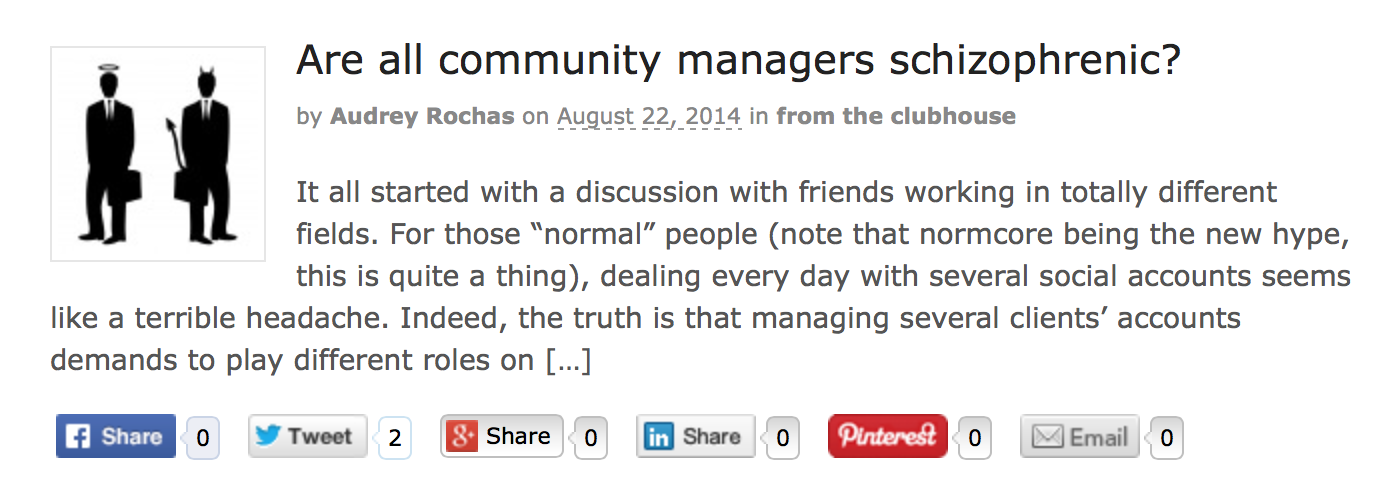
Comparing to 'normal' people is only one of many issues with this post.

Comparing to ‘normal’ people is only one of many issues with this post.


If substantially more established communication organisations like Edelman can make errors of judgement when it comes to discussing mental illness and mental health online, it is understandable that a content engine like Social Media Club is going to struggle from time to time.

Particularly frustrating is the Social Media Club’s inability or choice not to respond effectively to the criticism. As their twitter account clearly consists of scheduled tweets, with no editorial owner, the inappropriate link is being repeatedly tweeted with slightly amended wording at regular intervals. (An earlier tip from #SMClub points out that twitter is cracking down on identically worded scheduled tweets, so they are at least following practice here.) Despite multiple attempts to contact members via twitter, the link keeps coming…

Scheduled tweets mean an inability to rectify a problem

Scheduled tweets mean an inability to rectify a problem


Resources for mental health awareness

For information on effective social media practices relating to mental health and mental illness, here are a range of resources that will help social media professionals and community managers.

Useful Twitter Tags for mental health resources online

http://reports.youngandwellcrc.org.au/a-better-practice-guide-for-services/appendix/twitter-mental-health-hashtags/

Mindframe Media

An Australian initiative to support positive communication of mental health and illness in media, the arts and online.

http://www.himh.org.au/home/our-programs/community-media-and-arts-program/social-media-and-suicide-prevention

US National Institute of Mental Health

http://www.nimh.nih.gov/health/index.shtml

Mind Charity UK

http://www.mind.org.uk/news-campaigns/minds-media-office/

Sane Australia (including Stigma Watch)

http://www.sane.org/stigmawatch

This is only a small selection; there are extensive resources available.

Watching this space…

Is my response disproportionate? Perhaps. But this is an opportunity for Social Media Club to demonstrate their degree of thought leadership and practical steps to rectifying issues online when they occur.

What an ironic place the social web can be. Only a few tweets further up their timeline is a post on managing a social media crisis. If expertise is demonstrated by actions rather than rhetoric, it will be interesting to see how Social Media Club addresses this issue.

If you are a member of Social Media Club, I encourage you to contact them through your chapter to raise awareness of this issue.

The contact details for the Board and Volunteers are here:

http://socialmediaclub.org/contact-us

Postscript: As of the time of posting, the offending site appears to be down.

 

We're not in right now...

We’re not in right now…

Is Adobe Voice really a storytelling app?

When the interwebs went a little crazy for the announcement of Adobe Voice, the new iPad-based ‘storytelling’ app, my first reaction was skepticism. After all, ‘story’ and ‘storytelling’ are terms that get bandied around a LOT. Rather than be critical initially, I deleted a snarky tweet, went to the app store and gave it a try.

Wow. Let me repeat that. Wow. I created my first Voice in about 15 minutes. I’m not saying it’s going to win a Golden Lion, but as an example of what this can do a tool for pulling together an idea rapidly, you’ll get the idea.

As an occasional gadget geek, I have like shiny objects. But immediately I can see this has some real potential for helping people structure messages, think through what they want to say and get ideas across in a simple way. There are a variety of basic story structures to select from; promote an idea, explain a concept, share a personal experience, and even the classic hero’s journey. There are a selection of visual themes, the ability to draw from a broad range of icons, or the options to draw in files from the cloud, from Facebook or take a fresh pic on the spot. It is a very intuitive interface.

I’m excited by the potential something like this has for capturing ideas and helping people share their stories within organisations. In fact, I predict a Prezi like rush on people putting this to use. I’ll keep experimenting and save a longer post when I get some feedback from other #comms and #internalcomms folk.

In the meantime, give it a try and let me know how you would use this in your communication toolkit.

Note: I have no affiliation with Adobe and this is review is an independent perspective. 

According to Visua.ly, I'm more social than Gaga.

Visua.ly has been sharing great infographics for some time, and the ‘What character are you?’ Twitter app is the first free Twitter tool from their lab.

There are a number of ‘measurement’ tools for social media such as Empire Avenue, Tweetreach and Klout.  Some are serious, and some are the equivalent of the The Colour Clock: amusing and clever, but once visited quickly abandoned.

Visua.ly have taken a fun approach, blending data about reach, follower ratios and keyword analysis with some cute automated design to give you a ready made infographic of your ‘Twitter character’.

Future tools from their lab promise web-based infographic creation and tools for visualisation.
Here are my results having tried it out. (Note, the ‘versus’ pairing with Gaga was their random decision, not mine.)

Meaning Business Versus Lady Gaga

Meaning Business Versus Lady Gaga

What is your favourite social media ‘influence’ plugin?

Follow, Filter and Fold Together

How to use Twitter as a research tool and manage information overload

Catching ideas. Vivid Sydney Launch.

Sydney is doing its best to create information overload through May and June. With the Vivid festival, Creative Sydney, AMPlify festival, Sydney Writers Festival and TEDxSydney (just gone), Sydney Film Festival and a mass of related events, noone has any excuse to be bored.

With so many events, how can you keep track of the things that might be relevant to your industry or creative pursuits?

With Twitter and paper.li it can be quite easy. If you haven’t dived into the Twitterverse, this is the perfect opportunity to do so – with a purpose.

Follow.
Choose the organisations, companies or individuals that are of interest. There are a couple of ways of finding them on Twitter. The first is to search Twitter directly. This can be relatively simple for some organisations, but there can be so many different accounts, spellings and other factors that it can take time to track down the right one. The second, easier way is to go to the websites of the organisations of interest, find their official social media links and follow those.

Filter.
There are some great tools within twitter that you can use to begin filtering information so that you get more of what is of interest and less of the noise.

Lists. Taking a moment to create some categories for the accounts you want to follow will provide benefits down the track. You can then create a list for each of these major topics. For example, a communicator might choose to have a few lists such as:

  • Agencies
  • Thought Leaders
  • Clients
  • Media
  • Associations
  • Colleagues

As you find new Twitter accounts to follow, take the time to add them to one or more list categories.

Hashtags: The next essential Twitter tool is the hashtag. Take the time to explore and watch how those accounts that are of interest and see what tags are used.

Conferences and the ‘livetweet’. Livetweeting is one of the greatest aspects of Twitter. While there is seldom any substitute for being there at a great conference or event, finding and following the right tags for the event can be a great source of potted wisdom, triggers for new contacts and links to great information sources.

Find the official hashtags for the events and organisations that are of interest. You can create and save these searches.

Fold it together
There are a number of tools that let you aggregate this information.

Twitter clients. There will be a twitter client to suit you depending on your systems, mobile, aesthetic preferences. Hootsuite and Tweetdeck are two examples. These applications will allow you to view lists and searches easily.

The personal touch. The range of Twitter clients are excellent, but how do you make it a little more fun. paper.li is an excellent resource that enables you to specify lists, twitter accounts, search terms and hashtags and create a ‘newspaper’ from the tweets.

You have significant control over the content and can then share this information in a range of ways – via email, tweet or webpage. It integrates with Facebook as well as Twitter, so you have a great range of sources from which to draw.

There is a degree of ‘randomisation’ – not everything these sources produce will be included every time. It is still a great way of bringing together the collective content of all the sources that interest you in one space.

BrainBusiness is an example, sourced from the range of organisations, speakers and events underway across Sydney over the next few months.

//