Digital

#commsbingo – Conference Edition

It’s comms conference season, and that means the internet will be abuzz with 140 character insights from a range of events.

There are exciting – and challenging – emerging trends and new insights. We will see that in abundance at the excellent #IABC16 this week as the worlds leading communication membership association gathers around the theme of innovating global communication.

When you have been fortunate to have attended, chaired, co-curated and presented at a fair range of communication conferences and events*, you do start to see patterns in terms of insights and learnings. These recurring insights form a kind of communicators BINGO!

commsbingo600

#commsbingo

If we are to judge the progress of our profession by the wisdom shared on twitter from many comms events, then it seems we are caught in a loop. Yes, communication events do attract emerging practitioners. But seeing foundation knowledge shared as revelations does raise some questions about how effectively we are preparing communicators for professional practice.

If we are to continue to develop, to grow our collective commons and body of knowledge, we need to keep pushing for deeper insights, evolve our discussions and move beyond the foundations through research, education and creating connection.

Oh, and if you have any other #commsbingo insights, please tweet them so we can collate the common knowledge.

Share well!

*I have been a past chair and co-curator of Melcrum Strategic Communication & Digital Communication Summits in Asia Pacific, presented at the 2014 IABC WC in Toronto, and have been involved in communication professional development since before twitter was invented. Learn more about the Shorter COMMS Plan in this free webinar.
Engage employees with better communication choice

Technology has changed the way we consume information outside organisations, and it is natural that we want the same choices within. Companies that incorporate channel choice in their communication mix will win the war for engagement.

Find out the seven ways you can improve the choices for employee communication channels in this presentation.

For more information, see the article Changing channels: why employees demand freedom of information choice on LinkedIn Pulse.

When the Kotter change model creates a disconnect for mid-size change

Applying the Kotter eight-step model indiscriminately to project-level initiatives and operational change leads to challenges.

Generating a ‘sense of urgency’ for mid-level changes creates unnecessary competition for share of mind.

In a typical large organisation undergoing transformation, there are likely to be dozens of project-level initiatives and concurrent operational change.

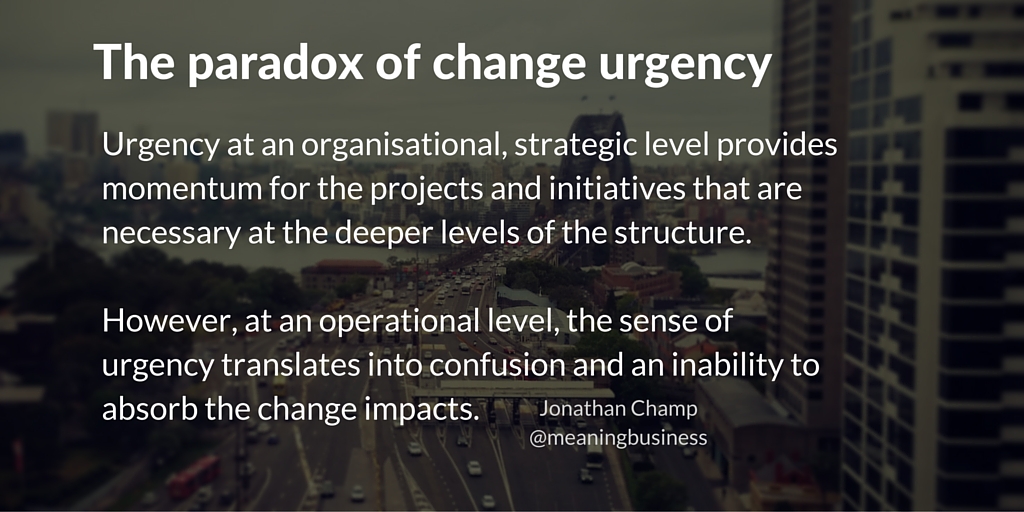
The paradox of change urgency (1)There is a paradox. Urgency at an organisational, strategic level provides momentum for the projects and initiatives that are necessary at the deeper levels of the structure. However, at an operational level, the sense of urgency translates into confusion and an inability to absorb the change impacts.

The underlying need for change at the project or operational level needs to be rolled up to the overall strategic imperative. Creating urgency around the detail of the change creates noise. This manifests itself as an increased request for project branding, change-specific communication channels.

Solutions include:

  • Ensure that the narrative of urgency remains at the enterprise level
  • ‘Bundle’ change impacts across programs
  • Implement at an operational or individual level as rapidly as possible based on the capacity for change

Institute change by designing for action

Consider the broader world beyond organisational life. As citizens and consumers, we conduct all kinds of complex behaviours and transactions ‘online’. The online environment changes constantly. Yet there is no change management plan for ‘the internet.’ Methodologies such at UX and User-Centered Design ensure that (successful) apps or sites or technologies are intuitive and based on making action easy to complete.

These disciplines do not apply only to online and technological change. The ability to design the ‘pointy end’ of change within organisations in a way that enables action at the right time without requiring substantial training or commitment becomes an opportunity for making continual concurrent change something that is easy to digest.

As Bill Quirke writes in Making the Connections, “Organisations are short changing themselves by not seeing communication through to the end – converting awareness into action. The real value of internal communication is to help business ends by enabling employees to turn strategy into action” (Quirke, 2008).

This is an excerpt from my chapter Kotter in context: is the classic change model damaging your mid-size change? in A Communicator’s Guide to Successful Change Management, edited by Craig Pearce.

So much information, so little time

Remember a little while back when you couldn’t go to a workshop or a conference on change, leadership, strategy, innovation or communication without the keynote quoting the Shift Happens/Did You Know? research?

I certainly used those numbers on more than one occasion with leaders trying to understand the shifting nature of communication in the social era, and the #futureofwork in a post-global economy. The 2015 version from Erik Qualman has updated references to social marketing and we see the exponential scale of social shift.

But if you want to immerse yourself in the real-time version of this, then interetlivestats.com is your go-to resource.

Watch this number rise for each social platform, realtime.

Watch this number rise for each social platform, realtime.

Here you can watch the sheer overwhelming volume of online activity tick over.

With so much data being created, accrued, shared and stored, it prompts a few questions:

  • how do we focus on the most useful things instead of getting carried with the current?
  • how do we add value to the volume, through interpretation and insight?
  • how do we maintain a voice while recognising ours is one of billions?
  • how do we make sure we are not just adding noise?

These aren’t questions just for communication professionals. They are core questions for us as people in the age of mass data.