An open letter to leaders and communicators in the Australian Public Service and Government Agencies impacted by the announcement to super-merge departments.
Dear government communications leaders, middle managers, department heads, branch heads
Another change with no notice. Another significant change that will have a significant degree of attention and negative press.
The MoG* guidelines don’t prioritise effective communication, so what do you do?
TOO LONG, DIDN’T READ
Following the announcement of merging 18 Federal Government departments into 14, the Machinery of Government process kicks in. For employees and line managers, the communication process as recommended in the MoG is too late in the change process and under-developed in terms of how to immediately communicate with those affected. Mid-tier roles and positions with direct reports will need ways to communicate through the uncertainty of the weeks until 1 February.
1. Make real communication a priority now
2. Listen
3. Stop waiting to communicate until there is more information
4. Be real
These are explained in detail below after the next three sections that provide some context.
Why *Machinery of Government guidelines aren’t enough for effective communication
The Australian Public Service employes around 150,000 people and other public sector organisations, around 90000 more.
Which means around a quarter of a million Australian employees found out about significant transformation to their workplace via the media yesterday when the Prime Minister announced the merger of 18 departments into 14. In his announcement, he did state there would not be job losses (aside from the five departmental secretaries) and that “those who were previously performing functions in the areas that I have talked about in other departments will now perform those functions in new departments.” That sounds simple.
This type of change, in corporate life known as a restructure and in the public service as a “Machinery of Government (MOG) change” are frequent enough to have a set of guidelines for managing the changes.
Interestingly, one of the first items is “hire people to help manage the change.”
Points 6 and 7 of the executive summary recognise that this might need some help…
6. Agencies are encouraged to appoint an independent advisor to manage the MoG process, facilitate negotiations and to help resolve contested issues. An independent advisor must be appointed if milestones are not being met.
7. It is good practice to complete a thorough due diligence exercise within the first five to ten days to identify complex or contested issues early. As soon as it is apparent that a MoG is complex or contested, an independent advisor should be appointed to identify potentially contentious issues and mediate a resolution.
Interestingly, the communication processes for the change are listed not anywhere under People Management, but as the last point under Planning And Due Diligence:
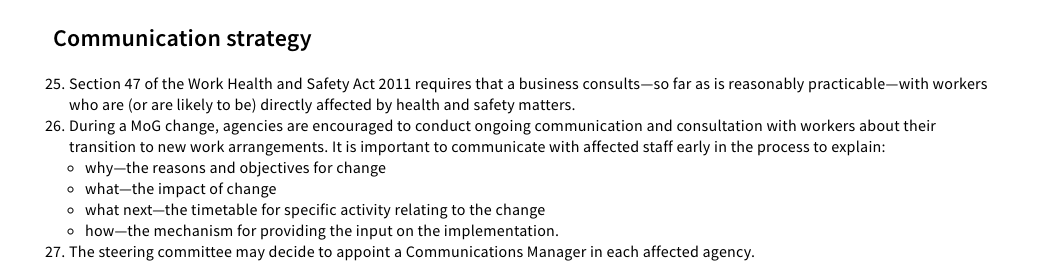
Communication strategy
- Section 47 of the Work Health and Safety Act 2011 requires that a business consults—so far as is reasonably practicable—with workers who are (or are likely to be) directly affected by health and safety matters.
- During a MoG change, agencies are encouraged to conduct ongoing communication and consultation with workers about their transition to new work arrangements. It is important to communicate with affected staff early in the process to explain:
- why—the reasons and objectives for change
- what—the impact of change
- what next—the timetable for specific activity relating to the change
- how—the mechanism for providing the input on the implementation.
- The steering committee may decide to appoint a Communications Manager in each affected agency.
Every time an employee hears something fundamental about their role from outside their organisation, trust is destroyed. For workers in the public service or other agencies, where the debate about functions, roles and efficiencies is played out in public, this is a difficult time. One that happens a lot.
Disruption disrupts – so denial and ‘business as usual’ is not an option
Major change – transformational change such as redefining the scope and remit of an agency, or bringing together separate departments – in the short term creates a range of predictable human responses and an accompanying downturn in productivity.
Study after study about the negative impacts demonstrate that a number of conditions are a guarantee of reduced trust and disengagement:
- Creating a high level of ambiguity by referencing major change without specific details
- Publishing information externally on change that impacts individuals publicly before communicating directly with them
- Providing no opportunities for input to change or its implementation
- Not gathering feedback
- Gathering feedback or research and not acknowledging the findings (even if the findings cannot be acted on it is key to be transparent)
- Making ‘big bang’ announcements that are not supported with ongoing change and communication initiatives.

A significant change is an opportunity to do things better. The approaches to implementing major changes can provide a catalyst for the kinds of departmental and team leadership and communication that build trust and strengthen the capacity for change. Organisations that get this right see benefits in productivity, trust and capability.
HOWEVER…THIS IS AN OPPORTUNITY
It is possible to communicate in a way that is humanistic and respects employees. A leaner public service will require higher levels of engagement to deliver ‘more with less.’ Yet, unless these changes are led effectively with meaningful employee communication, the support of the employees required to do the work will be eroded at exactly the time they will be needed the most. It’s a perfect time to do things better, because there is literally nothing to lose and everything to gain.
Four things public sector leaders can do now to make this not so shit for people impacted by the changes
1. Make real communication a priority now
Ministerial releases and intranet posts will not actually address the communication need at the heart of this challenge.
During uncertainty people need more real communication, and they need it from their immediate managers and supervisors fast. The majority of trust and engagement is attributable to the actions of leaders and supervisors, not memos.
Real means two-way face-to-face communication. Dialogue, listening, and discussion are part of the sense-making process for major change. This requires planning, commitment, time and skills – at a time when costs are being scrutinised. But the cost of not adopting real communication is another workplace-generation of low engagement and mistrust.
2. Listen
This is what it says on the tin. There are two levels of listening that are key. The first is as a leader, genuinely listen; take time to hear and acknowledge the experience of people facing change. The second is institutional listening; ensure that there are ways of capturing the attitudes, questions and concerns of employees. In environments where listening has not been high on the agenda this is a big – but symbolically priceless – change if it is done effectively. This doesn’t mean ‘just another survey’ or feedback box. It does mean engaging in dialogue about the reality of the changes.
3. Stop waiting to communicate until there is more information
There will always be an information gap. That doesn’t mean there should be a communication gap. Realise that not communicating is not an option. Talk about possible scenarios, and talk to facts. Talk about process in the absence of details of the change. When there is nothing to update, tell people there is nothing to update. Ask questions. Or listen.
When employees are reading and hearing something outside the organisation – whether in the news or on twitter – be prepared for some form of communication inside.
Making an announcement then asking employees to ‘discuss this with their manager’ without equipping managers and supervisors to have next-level conversations about change sets them up to fail. Even in organisations with healthy levels of engagement, it is not uncommon for there to be a pain point at the mid-level manager. They are expected to be the local face of change, yet are also typically facing the impact of changes themselves. If it’s important to increase the focus on communication during uncertainty for employees, it is twice as essential for managers.
4. Be real
Communication is never a substitute for strategy. If the strategy is going to be challenging, saying otherwise is not going to make it better. Although the public is accustomed to spin being part of the political discourse, spin has no place in employee communication.
Discuss what the future requires, what the current situation looks like, and what needs to happen to bridge that divide. For managers and supervisors, this means taking the time to be able to understand change and discuss it.
If you don’t know, say you don’t know. Establish links to the policy and strategic priorities you do have greater certainty about.
I’ve previously prepared some resources for leaders and people managers to help them – you – do this.
The seven things to do next
There are protocols in the Machinery of Government change approach, but they are not really going to create positive change.
You need to be managing communication effectively now.
- Have a plan
- Understand the context
- Put it in real language – no spin.
- Prioritise face to face and dialogue
- Listen
- Support managers in their role
- Communicate some more.
As change and uncertainty is a feature of every industry and sector and part of the landscape of business – the new normal – rather than accepting the negative consequences, leaders have the opportunity to face into the change and use the change as a catalyst for open, constructive communication.
But most of all, as managers you can try to make the change not feel like an episode of Utopia. Not communicating isn’t an option. Don’t be Rhonda.
Disclosure: I have provided advisory counsel, change and communication training to a number of Federal and State Government departments, agencies and directorates, both as Meaning Business and in my former role as Research & Content Director, Melcrum Asia Pacific.
An earlier version of this article was published prior to the 2014 Federal Budget when the Liberal Government announced it would cut over 10000 positions.





 Meaning Business