Year: 2014

Rumours of the change curve’s death are exaggerated

The change curve isn’t quite dead yet.


In their new study, The Agile IC Function, Melcrum have looked at how organisational complexity has changed the demands on managing the IC function. In outlining the research, Melcrum point to three ‘foundation beliefs’ about communication that are ready for disruption.

It is exciting work, providing real benefits for comms leaders looking for new approaches to manage in workplaces that are changing constantly.

The study points to the non-linear nature of transformation, and proposes that the curve has outlived its usefulness do to the degree of concurrent change within organisations. Here I am taking on the change curve’s right of reply. I would argue that it the change curve is the only model comms and leadership use for managing change, they are doing it wrong.

Models out of context are lines on a page

So many models in communication get applied to the wrong thing, and then practitioners are surprised when the result wasn’t what was intended. This particularly applies to applying linear approaches to complex interactions.

One of the most famous misuses of a communication model is that of the Shannon-Weaver ‘communication model.’ This linear model that shows the flow of ‘messages’ being diluted by ‘noise’ is still embedded in many resources about communication.

Here’s the problem. This model was designed to describe how data is diluted as electrical signals move through circuits. The context for the model had nothing to do with human communication*.

Shannon-Weaver's communication model has little to do with human communication

Shannon-Weaver’s communication model has little to do with human communication

But it is a compelling diagram. So much so that it has been taught as a model of communication in business schools, leadership training, and is in the top search results in response to the question ‘How does communication work.’

The problem isn’t with the model; it is with how it is used.

Let’s go back to the origin of the change curve: it was an interpretation of the work of Elisabeth Kubler Ross in her book On Death And Dying to look at how people move through bereavement in five typical stages.

 Denial | Anger | Bargaining | Depression | Acceptance

 It was then and remains a heuristic model for viewing human experience.

Organisational change practitioners in the 1970s and 1980s soon understood that there were parallels at work. Organisational change is a process of managing loss. Resistance to change is a form of loss aversion: loss of job, loss of status, and loss of certainty.
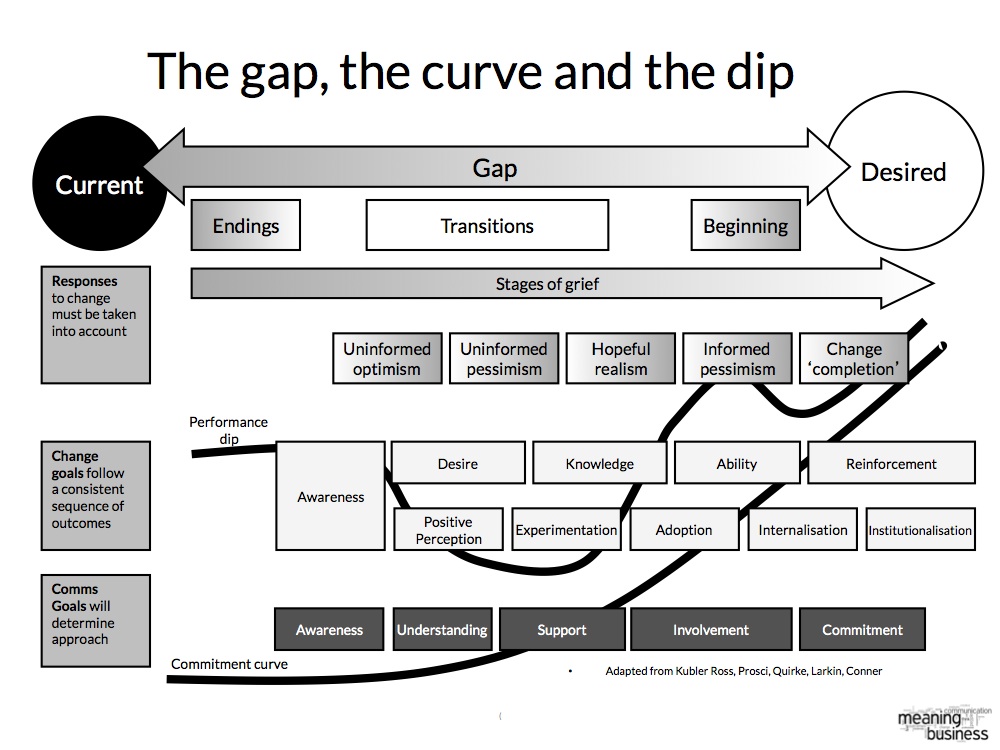
Many change models derive from the theory of loss

Many change models derive from the theory of loss

Download the PDF of all the models

Any leaders who has had to conduct layoffs face to face with employees, or who has had to manage a major relocation, or change a structure, or communicate that there will be no bonuses this year will have seen how accurate the change curve is in describing the individual response to change.

The challenge, as identified in the new Melcrum study, is that this response doesn’t ‘scale up’ very well. The individual experience of change can be understood, but how do you design change communication for people going through multiple iterations with no beginning and no end?

Babies and bathwater, and a little irony

Models are ways for us to understand behaviours and systems. They are a proxy for the real experience of the organisation. Understanding the balance between the context for the model and its pragmatic application is essential in order to navigate the world of work. Complexity in organisations means that few linear models will work in isolation. There are seldom the ‘simple answers’ practitioners crave.

Melcrum’s new study raises very important questions for IC leaders and encourages them to think smarter about how to deliver services in a changing workplace. Leaders do need to work with new models and approaches for this new environment.

This means challenging lots of assumptions and existing processes as they ask leaders and partners to change their understanding of what contemporary IC practice is. And that’s going to provoke anger and denial in some practitioners before they accept it and commit to working in new ways.

As they introduce new ways of working, IC leaders can expect to face resistance from the ExCo to doing things in new ways. Or their HR Director may not initially be supportive of changes to the structure to be more adaptive. And the manager in the business area who is used to embedded communication support will almost certainly resist having resources taken away.

And this is exactly where the understanding (rather than the rigid application) of the change curve will remain useful. Maybe there is some life in the old curve yet.
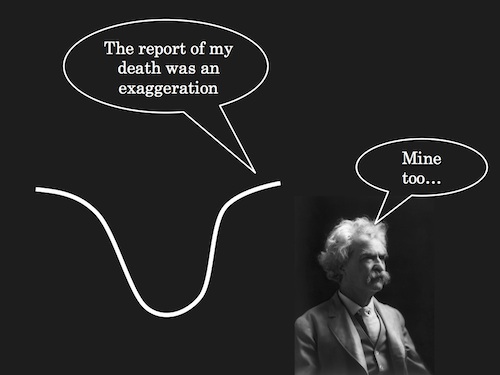
The change curve still has some life in it yet.

The change curve still has some life in it yet.

*For an excellent description of the birth of the Shannon-Weaver model, I recommend James Gleick’s The Information.

Disclosure: From 2012-13 I was Research & Content Director, Asia Pacific for Melcrum. These views are my own.

What leaders should expect from their communication counsel

As a leader, what should you expect from a communication strategist?

What a great question, and the subject of a recent post on the LinkedIn CommsScrum Group (requires membership). Having worked with C-suite, executive and Board-level leaders across a range of industries, here are some things I think leaders should expect from their comms strategists.

They will treat you as a person. Trust is a process of reciprocity, but it pays dividends. Experienced comms strategists will understand that leaders are human. They will recognise that in business, an executive can seldom get to where they are without some communication strengths, but that their current positions may mean that constructive feedback about areas for improvement isn’t always forthcoming. A good strategist will seek to understand the executive’s business goals and personal context in order to develop programs that help to achieve both.

They will listen. And they might ask more questions than you may be used to from anyone except the CEO or Board. As an executive, you have so many aspects of the business in your head that making connections, judgements and evaluations about your operation is instinctive. Experienced comms strategists will seek to understand your business priorites from your perspective. And in the process, they will (depending on their approach) seek to understand the ‘why’ before helping you with the ‘what’.

They will build on your strengths. An experienced communication strategist understands that protecting the authentic strengths of a leader is a key priority. They will take time to understand what you are best at. This isn’t the same as never asking you to do something you aren’t comfortable with; strengths are sometimes underplayed.

They will talk to you about the business, not just about communication. Experienced comms strategists are business people using communication as a driver for business results. They will ask about goals, about performance, about metrics, about culture, about competition, about risks and issues. And then they will start talking about communication. If they jump straight to the comms stuff, beware.

With that in mind:

  • Be clear about your expectations and in describing what a successful engagement will look like from your perspective.
  • Be open to professional counsel with a view to building trust.
  • Be prepared to contribute time, opinions and knowledge in the development of strategy.


Not the zombie apocalypse

Preparing to work with a communication advisor doesn’t need to be scary

Social Media Club Fail and the perils of scheduled tweets #SMClub

Update: Following the publication of my article, there was formal contact from Social Media Club apologising for the post and acknowledging that appropriate action would be taken, and the original post by Audrey Rochas has been removed from their site

12 hours after the original contact, Social Media Club have apologised and removed the original post by Audrey Rochas

12 hours after the original contact, Social Media Club have apologised and removed the original post by Audrey Rochas


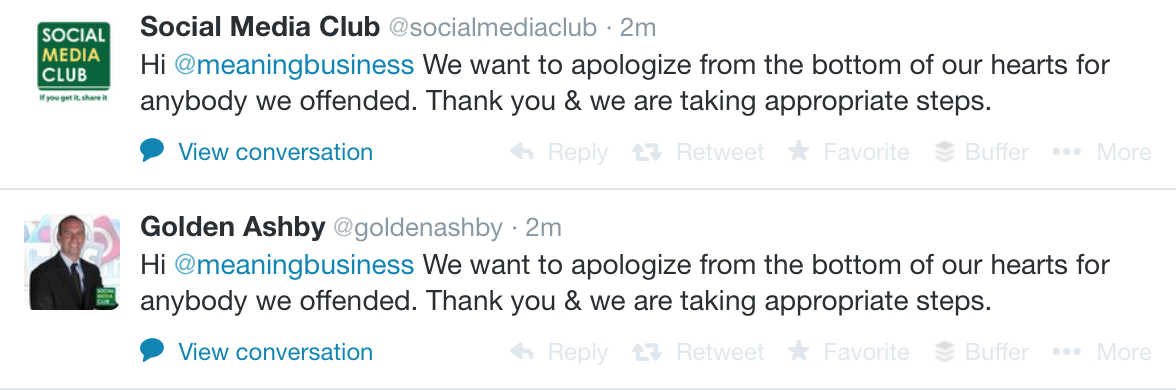
Earlier today, the scheduled tweets of the Social Media Club, a loosely organised social media promotion organisation, posted the following tweet:

The offending tweet from @socialmediaclub

The offending tweet from @socialmediaclub

As a communicator, I am interested in community management, effective use of social tools such as Twitter to build awareness and drive engagement.

As a human, I am also interested in social good, including mental health. I have family members who have experienced a range of long and short term mental illnesses, have lost extended family and friends to suicide and my partner works in mental health education. It’s kind of a vested interest, and as such I care about representations of mental illness online, in the arts and in the workplace.

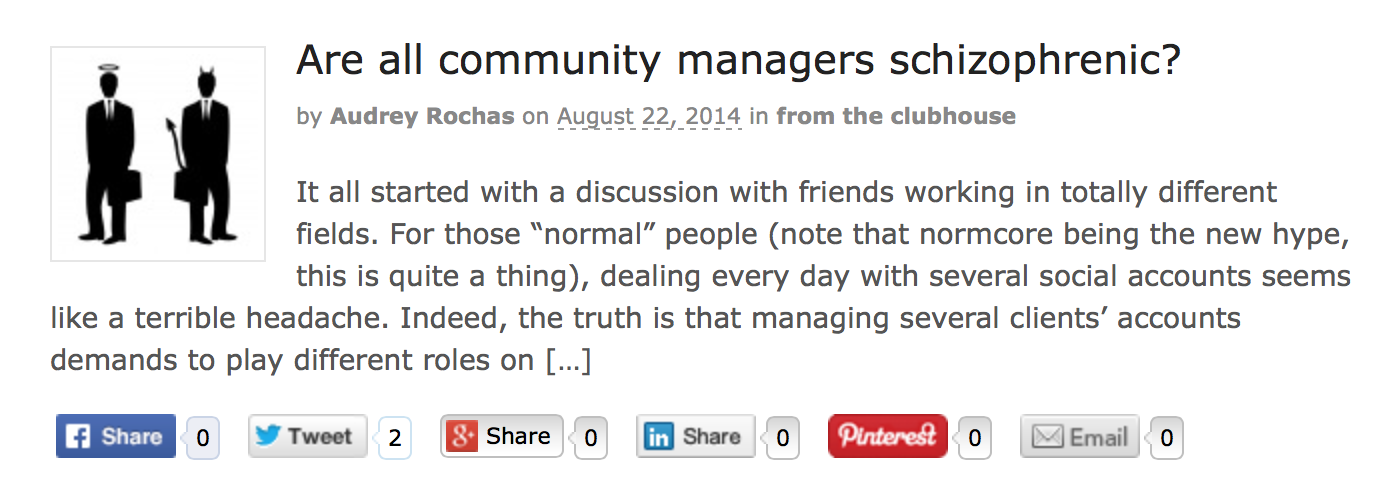
So my ire was already rising when I clicked through to the article, which perpetuates the ‘mutiple personality’ myth of schizophenia throughout. Most offensive however, was the accompanying image of the ‘angel and demon’.

The offending imagery attached to Social Media Club post

The offending imagery attached to Social Media Club post

There is a long history of equating mad with bad, which goes a long way to contributing to the lack of awareness of mental illness, the perpetuation of outdated knowledge and stereotypes.

Am I overreacting? Considering Social Media Club positions itself as an organisation that promotes good online practices, and has over 150,000 followers on Twitter, and 42000 likes on Facebook, it has a substantial potential reach. As people working in communication, marketing and social media, there is a responsibility to perpetuate constructive and factual information.

If there was an editorial process for inclusion of material on the blog, it has clearly failed to pick up the tone and issues relating to the post.

Comparing to 'normal' people is only one of many issues with this post.

Comparing to ‘normal’ people is only one of many issues with this post.


If substantially more established communication organisations like Edelman can make errors of judgement when it comes to discussing mental illness and mental health online, it is understandable that a content engine like Social Media Club is going to struggle from time to time.

Particularly frustrating is the Social Media Club’s inability or choice not to respond effectively to the criticism. As their twitter account clearly consists of scheduled tweets, with no editorial owner, the inappropriate link is being repeatedly tweeted with slightly amended wording at regular intervals. (An earlier tip from #SMClub points out that twitter is cracking down on identically worded scheduled tweets, so they are at least following practice here.) Despite multiple attempts to contact members via twitter, the link keeps coming…

Scheduled tweets mean an inability to rectify a problem

Scheduled tweets mean an inability to rectify a problem


Resources for mental health awareness

For information on effective social media practices relating to mental health and mental illness, here are a range of resources that will help social media professionals and community managers.

Useful Twitter Tags for mental health resources online

http://reports.youngandwellcrc.org.au/a-better-practice-guide-for-services/appendix/twitter-mental-health-hashtags/

Mindframe Media

An Australian initiative to support positive communication of mental health and illness in media, the arts and online.

http://www.himh.org.au/home/our-programs/community-media-and-arts-program/social-media-and-suicide-prevention

US National Institute of Mental Health

http://www.nimh.nih.gov/health/index.shtml

Mind Charity UK

http://www.mind.org.uk/news-campaigns/minds-media-office/

Sane Australia (including Stigma Watch)

http://www.sane.org/stigmawatch

This is only a small selection; there are extensive resources available.

Watching this space…

Is my response disproportionate? Perhaps. But this is an opportunity for Social Media Club to demonstrate their degree of thought leadership and practical steps to rectifying issues online when they occur.

What an ironic place the social web can be. Only a few tweets further up their timeline is a post on managing a social media crisis. If expertise is demonstrated by actions rather than rhetoric, it will be interesting to see how Social Media Club addresses this issue.

If you are a member of Social Media Club, I encourage you to contact them through your chapter to raise awareness of this issue.

The contact details for the Board and Volunteers are here:

http://socialmediaclub.org/contact-us

Postscript: As of the time of posting, the offending site appears to be down.


We're not in right now...

We’re not in right now…

Essential persuasion tools for internal communication

Maslow’s Hierarchy of Needs 2.0

I’m a little bit Pavlovian when it comes to Maslow’s Hierarchy of Needs. Every time I see it, I have an urgent need to share it with communicators. This is driven in part by the blank looks from managers, or worse still, communicators I have occasionally encountered when talking to them about engagement. Yet this is one of the fundamental ‘ways of knowing’ that informs our communication practice.

That’s why this post from the the clever content marketers, curators and link-baitering masters at Buffer caught my eye. They have curated 10 very useful theories of persuasion, including Maslow’s Hierarchy and the Reciprocity Norm. These are all useful for communicators.

I’d be interested to hear about what models you find most useful. Add your suggestions in the comments.

Social Media Influence: 10 Theories to Know For Greater Persuasion.