Author: jonathanchamp

#writing #comms #internalcomms #leadership #engagement #IABC #csr #collaboration #story #screenwriting #media #change | opinion = own

Roadblock or dead end? Handling setbacks in change communication

A roadblock is a temporary state. A dead end is a point from which one must turn around and go back.

There is a moment in the wonderful Pixar film “A Bug’s Life” which simultaneously parodies the masses of self-help self-talk and provides a very simple mantra for change. A leaf falls into the path of the row of ants who are trying to gather food in time for the bully grasshoppers.

The ants freak out, the trail is broken:
Worker Ant #1: I’m lost! Where’s the line? What do I do?
Worker Ant #2: Help!
Worker Ant #3: We’ll be stuck here forever!
Mr. Soil: Do not panic, do not panic. We are trained professionals. Now, stay calm. We are going around the leaf.

All communication plans – in fact all projects – hit road blocks. There is an art to knowing when a roadblock is a temporary situation that can be addressed, or a true dead end. Even experienced project managers can waste resources – time, money, goodwill and energy by not recognising when a dead end is just that.

How do we recognise a dead end?
The signs are clear – “wrong way, go back”. These signs may be in the language of senior leaders, sponsors or customers. Words like never, can’t, forbid, refuse, may be the verbal equivalent of the dead end, or they may be road blocks, placed in the way because people are yet to understand the change.

“Hang on, doesn’t real change require us to break through and not take ‘no’ for an answer?” I hear you cry. Well, yes and no. Leading, managing and communicating change means that we need to continually search for other ways, and to determine how we go decide when to “go around the leaf” and when to wait for the roadblock to be cleared.

A dead end does not mean that the destination is abandoned. Rather, it means that the route there needs to be different.

A roadblock is a temporary state. #change #meaningbusiness

This post was first published in 2006. It remains totally relevant today!

What style of language do scientists really prefer?

The evidence is in: scientists prefer clarity in technical and scientific communication .

Tom Freeman's avatarStroppy Editor

“Our readers are intelligent, well-educated scientists. Why should we make our language dumbed-down, patronising and imprecise in the name of ‘readability’?”

It’s a fair question. Here’s the answer.

Never talk down to your readers. But never waste their time, either. And scientists, while intelligent and educated, are also busy. As well as their research, they may have teaching, management or clinical duties to perform, funding applications to write, presentations to plan, journals to keep up to date with… They don’t have time to wade through verbiage in search of facts.

If you’re writing about something complex, then of course you need to give all the necessary detail. If you’re writing for specialists, you can use their specialist terms. But you don’t need to add verbal complexity beyond that. Keep it clear and direct. This makes your writing more efficient and more likely to succeed in communicating your message. It’s also…

View original post 1,044 more words

How stories are told around the world

Sensemaking takes many forms.

Making your message work for everyone

There is a well known Indian folk story that describes how a group of blind men who encounter an elephant all have very different descriptions based on their individual experience of the parts, rather than the whole. When we communicate, it is important to break down ‘the elephant’ into the parts that make the most sense to the most people.

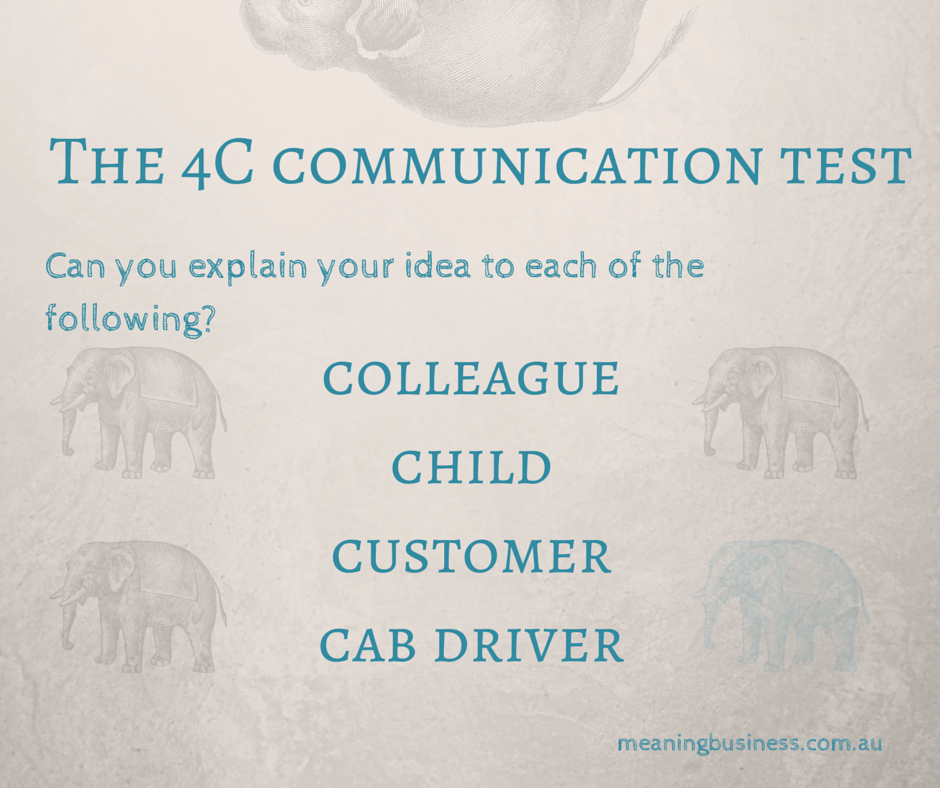
The 4C Communication test ensures that your messages are clear enough to describe the whole to four very different people.

4C Communication Test

  • A colleague: This tests clarity and depth of understanding. It is the ‘fact check’ version of a message. A colleague will be able to understand the concepts and the detail of the message. Framing your message for a colleague tests for credibility.
  • A child: This forces us to use the most essential elements to create a simple message. Simultaneously conceptual and concrete, the ‘for a child’ test is a challenge of eliminating all but the core. Framing your message for a child tests simplicity.
  • A customer: This message test asks us to focus on the ‘so what’ of a message and to consider the relevance to the ‘other’. How does this help me? Why should I care? Framing your message for a customer tests relevance.
  • A cab driver: Be prepared to explain yourself and to hear a counter-perspective*. Does your message stand up to the scrutiny of a stranger? Framing your message for a cab driver tests for opposition.

There are other variations of this. Consider the personas that would be useful tests in your environment.

*In no way am I suggesting that cab drivers are essentially argumentative. However, my unscientific sampling spread over many years would indicate that many are conversationalists who have a sense of public opinion, often based on talk radio.