Author: jonathanchamp

#writing #comms #internalcomms #leadership #engagement #IABC #csr #collaboration #story #screenwriting #media #change | opinion = own

Don’t let key safety and compliance messages slip through the cracks

This post originally appeared in hrdaily.com.au.

Constant change is the new normal in business, so organisations need to find a way to communicate crucial safety and compliance messages to employees above the din, says communications expert Jonathan Champ.

In an environment where staff are drowning in push communications like email and research shows very few organisations are less complex than they were five years ago, companies need to set measurable objectives for safety communications over the long term, Champ says in an HR Daily Premium webcast.

(While focused on safety, the messages apply to all compliance-related communication.)

“Many organisations have significant competing priorities,” he says. “People are shouting for more attention. A specialist topic such as safety becomes only one of a number of things organisations are trying to have people be aware of.”

Organisations should have four key goals in their internal communications strategy, says Champ, the founder of Meaning Business. They should create an appetite for essential safety information; they should amplify those messages through various channels available to them; they should avoid one-hit announcements and structure campaigns for the long haul; and they should build a culture genuinely committed to workplace safety.

Crucial to this strategy is making safety and compliance messages easy to digest with clear guidelines to staff about what is expected of them. And they should be spiced up with a sense of “what’s in it for me”, Champ says.

Resistance to change

Employees often resist change when it is brought in and communicated from above, Champ says, and there are three typical causes of that.

“What we know about change communication is that people will tend to resist the new and that’s quite predictable,” he says. “But there are three different kinds of resistance and it’s important to understand what kind of resistance there is here.”

The first is when people don’t know or understand what they need to do and what is required of them. Information needs to be made available and accessible to everyone using multiple channels, Champ says.

The second is when staff lack the skills, resources or capacity to enact the change. Feedback processes are needed to genuinely help employees through the problems they are facing.

The third is they simply are not willing. This is often due to a “values disconnect” and it is important to build trust through openness about the importance of the change, Champ says.

What’s in it for me?

Motivating workers is key to successfully communicating safety and compliance messages, and this needs to be done through a balance of what Champ calls “compliance” and “commitment”.

Compliance is an academic understanding of the things that need to be done.

“Compliance is driven by external motivators – you will be in trouble if you don’t do it, there will be fines, there will be disciplinary processes,” Champ says. “That’s valid, we need to do some of those things.”

But a sense of commitment comes instead from an innate desire to do the right thing. When that exists, employees are able to act within guidelines instead of strict processes.

“Instead of being seen to do the right thing it’s about actually doing the right thing,” Champ says. “They’re the kinds of outcomes you would strive for if we’re trying to drive commitment instead of just compliance.”
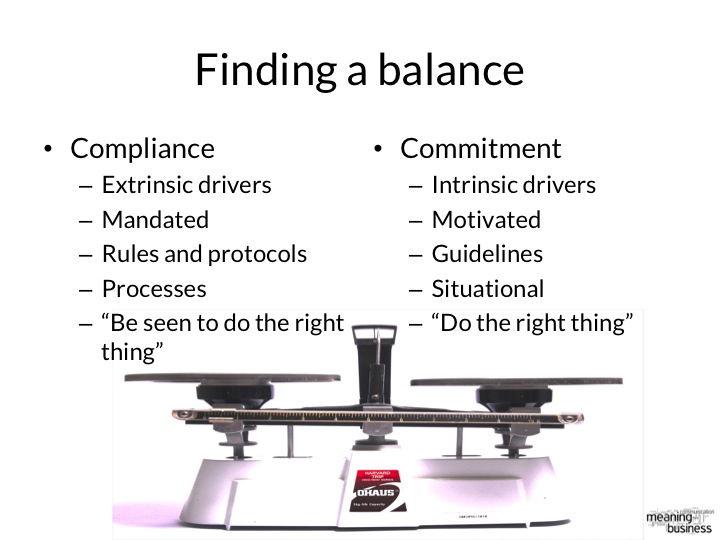
Finding the right balance between commitment and compliance is important for  communicating mandatory requirements.

Finding the right balance between commitment and compliance is important for communicating mandatory requirements.

One factor that can drive compliance and also commitment is a bit of fear, Champ says, in the form of demonstrating the risks of non-compliance. It is showing that if people do the wrongs things, there could be personal liability, organisational liability, and even injury or death. But companies have to be careful using fear as a motivator.

“Fear can be a successful driver of behavioural change,” he says. “A lot of behaviour change campaigns on social issues like drink driving or smoking campaigns rely on a fear component. But it’s complex behaviourally and not something to dabble with in your first efforts of communicating safety in your organisation.”

HR Daily Premium subscribers can watch the full webcast – or excerpts – by clicking here

What can communication professionals learn from the NYT Innovation report?

Media as an industry has an ability to cannibalise itself. Journalists are by nature inquirers and investigators. They look for the story and have a need to present it. It is not surprising then that a mountain has been written about the NYT internal Innovation Report. The leak of report, along with the executive departure drove a lot of speculation, commentary, opinion, and tweetage.

That a major media organisation would prepare a strategic thought-paper on the future impacts of their market should not be surprising. The Innovation report is a significant thought piece with real lessons for industries well beyond its implications for the paper itself, media and publishing.

Nieman Lab does an excellent job of examining the implications from the media industry perspective.

Beyond the media

There is also some excellent analysis of the content of the report from other commentators, looking at it as a call to action for an organisation needing to reinvent in a changing market.

David Armano’s perspective is a standout, categorising the insights into the four topics of agility, culture, talent and customer-centricity.

David Armano’s dissection of the strategic elements of the NYT Innovation Report


Ezra Klein at Vox highlights the report’s excellent explanation of distruption. This diagram explains the three modes of disruption in the clear style you would expect from NYT writers.

NYT Innovation report’s explanation of disruption, via Vox.

Australian workplace and digital analyst Paul Wallbank extracts three lessons for businesses: being digital first, breaking down the silos, and ensuring your business is discoverable.

Six lessons for communicators

The full report is worth the investment of time to read by any communicator, change agent or strategist.

There are a number of change studies that demonstrate that effective context-setting is an important part of enabling employees to sense-make during change. By providing clear background to the market your organisation operates in, you are preparing the field for proactive or reactive initiatives in the future. The NYT Innovation report is an interesting and important model of what that contexualised call to action can be.

There are six themes outlined in the NYT Innovation Report that provide a very simple compass for internal communicators considering how to reach employees who are time poor, information-laden and who have different needs.

1. Discovery

“We need to think more about…packaging our work in more useful ways” With the volume of information growing, reduction and control become limited-success strategies. How do you ensure your content is discoverable, at the right time?

2. Promotion

Ensuring information is promoted means not just ‘publishing’ but by sharing, by amplifying, and by use of peers. There is a fine balance between push and spam. Segmentation becomes critical, as does understanding the needs of the employee to target promotion of relevant, useful content.

3. Connection

Seeking ways to ensure audiences – employees – can participate, comment, create and contribute is an essential component of communication, engagement and change. Whether though user generated content, internal ‘crowdsourcing’, communities, and networks, connection is the the key to relevance and ultimately the path to engagement.

4. Experimentation

Promoting active experimentation, the capacity to fail fast, iterate and learn is a core skill and critical to building the agility of any communication function. Experimentation and connection can work in partnership, through the use of pilot groups, advisory communities and user experience (UX) work.

5. Influencers

In complex environments, the role of the subject matter expert, the thought leader or the process lead extends to filtering and amplifying key information, themes and messages relevant to their specialisation. Collaborative platforms and enterprise social networks enable this.

6. Market context

The competitor cheat sheets in the report are succinct and frank. Do you provide employees with concise information about the others in your market? Is this information purely product and service comparison, or does it go deeper into comparative strengths and weaknesses.

Your view

I’m interested in communicators views on all aspects of the report – the content, the format, the debate and analysis surrounding its leak. Join the conversation by leaving a comment.


Lord David Puttnam: Online commercial strategies have ‘actively damaged’ news and information relaying | The Drum

As part of Bite’s Stop Content Pollution event, filmmaker and digital ambassador Puttnam spoke about the challenge facing communicators in a crowded content marketplace.

I’d be very surprised if there were graduates coming out of media courses who had been told that their principle job is storytelling. I would be very surprised. They are being told that their job is impact. Lord David Puttnam

Lord David Puttnam

Lord David Puttnam

via Lord David Puttnam: Online commercial strategies have ‘actively damaged’ news and information relaying | The Drum.

Pixar President Ed Catmull on open communication

Communication needs to be between anybody at any time. Outside the structure, and outside the order.

Ed Catmull, President Pixar

In a short video interview, Ed Catmull talks about the challenges to open communication on Toy Story.

via Fastcompany

Ed Catmull, President Pixar