Sensemaking takes many forms.
How stories are told around the world
Sensemaking takes many forms.
Sensemaking takes many forms.

[Update: This post was written in 2015.]
I have known that things aren’t always the way you first see them since I was a child. My rainbow does not look the same as the rainbow that the vast majority of you see. I don’t see the explosion of red when bottlebrush is in season and I am just as likely to be wearing a purple tie thinking it is blue as I am a grey one thinking it is green.
I am colourblind.
For the most part, this colour uncertainty is something curious. The most serious consequences for me included not being able to choose being a pilot, a policeman or an electrical engineer as a career.
During a working bee I once spent half an hour looking for tins of green paint that turned out to be the very same tins of pink paint I had moved aside to commence my search. Other volunteers were dispatched to search for me, and when they arrived, they pointed to the cans that I had placed aside. The look on their face told me they couldn’t understand how I couldn’t see this.
Over the last two days I have found it fascinating to see how people have responded to the #thedress, the phenomenon of the photo of a dress that appears to be different colours depending on the viewer.
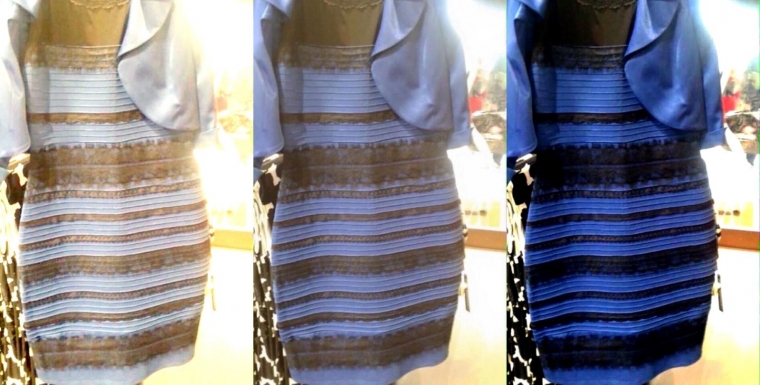
What has stood out is the degree that people are ready to become entrenched in their position that the dress either has to be white-gold, or blue-black.
This little internet storm highlights one of the biggest challenges to communication. Everyone who is sure the dress is one colour and not the other (just like the working bee paint rescuer) struggle to accept that there could be another way to see things.
This post from arts and culture site Hyperallergic on the philosophical roots of the reaction to #thedress explores the how these experiences of ‘otherness’ challenge our understanding of the world.
But the gift that I have been given by my other-sightedness is a daily sense that there may be another way. Over the past twenty years, my work as a communicator and change manager is to help leaders, project managers, employees consider that blue might be gold and white might be black.
There is always another way to see something.
It is such a great, simple metaphor for differences in perception. Craig Silverman at Poytner has written a wonderful piece on what the whole episode can teach journalists which I recommend to anyone involved in writing, communicating and change. As Silverman writes:
“The simple truth is our brains process information in ways that can lead us astray. This is something every journalist needs to be aware of and account for in the work we do.”
For the record, I have no opinion either way on the colour of the dress. There are some excellent explainers about the phenomenon from New Scientist and IFLScience.
 Meaning Business