Month: March 2015

What style of language do scientists really prefer?

The evidence is in: scientists prefer clarity in technical and scientific communication .

Tom Freeman's avatarStroppy Editor

“Our readers are intelligent, well-educated scientists. Why should we make our language dumbed-down, patronising and imprecise in the name of ‘readability’?”

It’s a fair question. Here’s the answer.

Never talk down to your readers. But never waste their time, either. And scientists, while intelligent and educated, are also busy. As well as their research, they may have teaching, management or clinical duties to perform, funding applications to write, presentations to plan, journals to keep up to date with… They don’t have time to wade through verbiage in search of facts.

If you’re writing about something complex, then of course you need to give all the necessary detail. If you’re writing for specialists, you can use their specialist terms. But you don’t need to add verbal complexity beyond that. Keep it clear and direct. This makes your writing more efficient and more likely to succeed in communicating your message. It’s also…

View original post 1,044 more words

Making your message work for everyone

There is a well known Indian folk story that describes how a group of blind men who encounter an elephant all have very different descriptions based on their individual experience of the parts, rather than the whole. When we communicate, it is important to break down ‘the elephant’ into the parts that make the most sense to the most people.

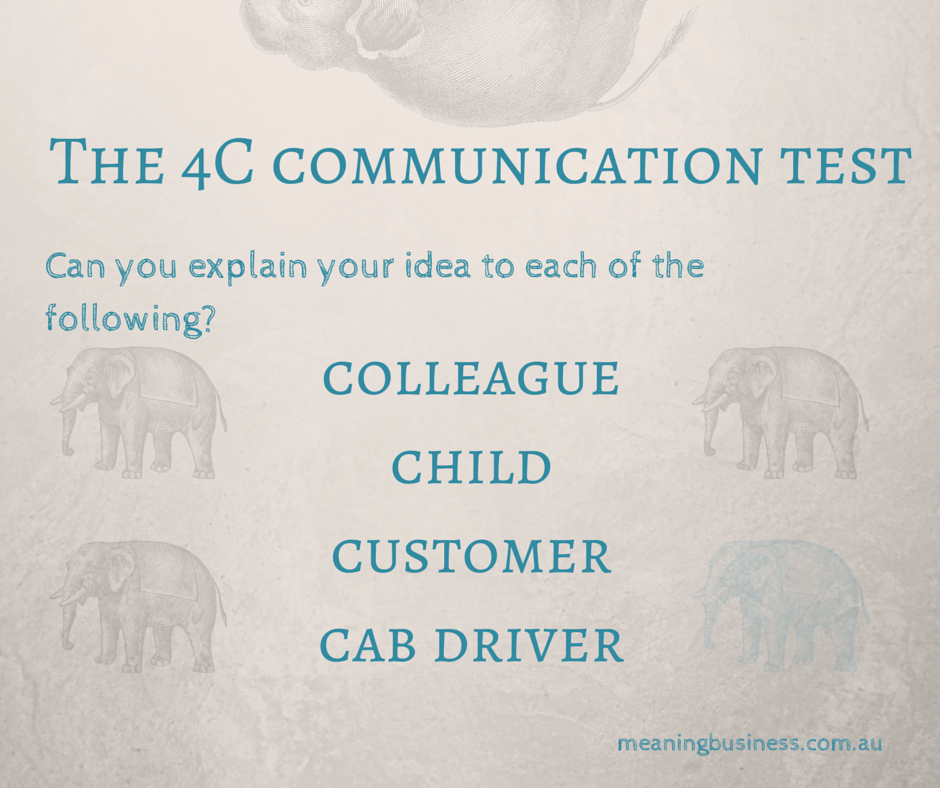
The 4C Communication test ensures that your messages are clear enough to describe the whole to four very different people.

4C Communication Test

  • A colleague: This tests clarity and depth of understanding. It is the ‘fact check’ version of a message. A colleague will be able to understand the concepts and the detail of the message. Framing your message for a colleague tests for credibility.
  • A child: This forces us to use the most essential elements to create a simple message. Simultaneously conceptual and concrete, the ‘for a child’ test is a challenge of eliminating all but the core. Framing your message for a child tests simplicity.
  • A customer: This message test asks us to focus on the ‘so what’ of a message and to consider the relevance to the ‘other’. How does this help me? Why should I care? Framing your message for a customer tests relevance.
  • A cab driver: Be prepared to explain yourself and to hear a counter-perspective*. Does your message stand up to the scrutiny of a stranger? Framing your message for a cab driver tests for opposition.

There are other variations of this. Consider the personas that would be useful tests in your environment.

*In no way am I suggesting that cab drivers are essentially argumentative. However, my unscientific sampling spread over many years would indicate that many are conversationalists who have a sense of public opinion, often based on talk radio.