change

The changing world of change communication

Communication professionals are in the business of change. We design campaigns to understand perceptions and attitudes. At our best, we can contribute to shifting understanding, increasing awareness and influencing intentions.

Intent is key for internal communication. We communicate to create change.

Intent is key for internal communication. We communicate to create change.

And yet, when it comes to the processes of managing change within organisations, the world of communication and the world of change can seem like different planets.

Short-term versus long term

PR – particularly when not in-house- is frequently a short-cycle activity. Communicators get in, understand a problem, an issue or a stance, manage our campaign, and then get out again.

Three years ago, I was facilitating a discussion with communication professionals about the differences between internal communication and external communication, and why specialists in the two fields don’t always see eye to eye. One very experienced practioner summed up the challenge well. At the risk of making broad generalisations, he indicated that external comms practitioners are adept at short cycle communication, deep diving into an issue as required, working with the news cycle and then moving on to the next issue. By contrast, he felt that internal communicators may be used to longer time scales for achieving changes in culture or engagement, looking holistically at the interdependencies and ongoing employee experience.

Historically that may have been correct, but communicators need to be agile when communicating change internally and externally. This means being adaptable and responsive to circumstances that may be constantly evolving. It requires communicators to be active agents of change.

Change agents and Change Agents

Organisational development and transformational change, process change, operational change management: each are different varieties of change that rely on different communication methods and approaches.

There is more to managing (most types of) change than communication alone. Understanding the key steps in the change management process, the different types of organisational change, and the key roles for leadership, communication, training and even HR, helps create the partnerships that lead to effective change.

We explored these ideas and more in the  PRIA webinar, The Business of Change, The Art of Communication on 14 November. PRIA members will ion be able to access the webinar recording, and the slideshare is available.

In the session, we defined and aligned approaches to change communication for in-house practitioners working on major projects, PR and comms professionals who are part of an agency response to change, or even managing changes in your own business.

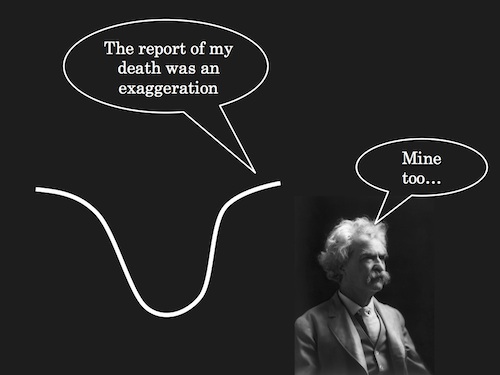
Rumours of the change curve’s death are exaggerated

The change curve isn’t quite dead yet.


In their new study, The Agile IC Function, Melcrum have looked at how organisational complexity has changed the demands on managing the IC function. In outlining the research, Melcrum point to three ‘foundation beliefs’ about communication that are ready for disruption.

It is exciting work, providing real benefits for comms leaders looking for new approaches to manage in workplaces that are changing constantly.

The study points to the non-linear nature of transformation, and proposes that the curve has outlived its usefulness do to the degree of concurrent change within organisations. Here I am taking on the change curve’s right of reply. I would argue that it the change curve is the only model comms and leadership use for managing change, they are doing it wrong.

Models out of context are lines on a page

So many models in communication get applied to the wrong thing, and then practitioners are surprised when the result wasn’t what was intended. This particularly applies to applying linear approaches to complex interactions.

One of the most famous misuses of a communication model is that of the Shannon-Weaver ‘communication model.’ This linear model that shows the flow of ‘messages’ being diluted by ‘noise’ is still embedded in many resources about communication.

Here’s the problem. This model was designed to describe how data is diluted as electrical signals move through circuits. The context for the model had nothing to do with human communication*.

Shannon-Weaver's communication model has little to do with human communication

Shannon-Weaver’s communication model has little to do with human communication

But it is a compelling diagram. So much so that it has been taught as a model of communication in business schools, leadership training, and is in the top search results in response to the question ‘How does communication work.’

The problem isn’t with the model; it is with how it is used.

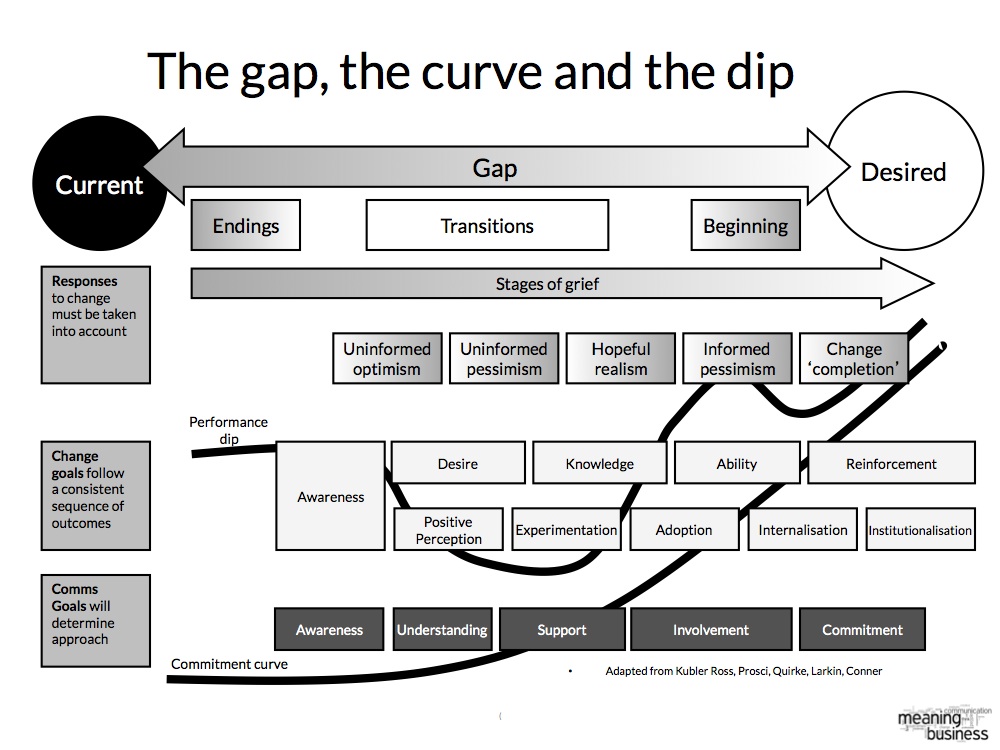
Let’s go back to the origin of the change curve: it was an interpretation of the work of Elisabeth Kubler Ross in her book On Death And Dying to look at how people move through bereavement in five typical stages.

 Denial | Anger | Bargaining | Depression | Acceptance

 It was then and remains a heuristic model for viewing human experience.

Organisational change practitioners in the 1970s and 1980s soon understood that there were parallels at work. Organisational change is a process of managing loss. Resistance to change is a form of loss aversion: loss of job, loss of status, and loss of certainty.

Many change models derive from the theory of loss

Many change models derive from the theory of loss

Download the PDF of all the models

Any leaders who has had to conduct layoffs face to face with employees, or who has had to manage a major relocation, or change a structure, or communicate that there will be no bonuses this year will have seen how accurate the change curve is in describing the individual response to change.

The challenge, as identified in the new Melcrum study, is that this response doesn’t ‘scale up’ very well. The individual experience of change can be understood, but how do you design change communication for people going through multiple iterations with no beginning and no end?

Babies and bathwater, and a little irony

Models are ways for us to understand behaviours and systems. They are a proxy for the real experience of the organisation. Understanding the balance between the context for the model and its pragmatic application is essential in order to navigate the world of work. Complexity in organisations means that few linear models will work in isolation. There are seldom the ‘simple answers’ practitioners crave.

Melcrum’s new study raises very important questions for IC leaders and encourages them to think smarter about how to deliver services in a changing workplace. Leaders do need to work with new models and approaches for this new environment.

This means challenging lots of assumptions and existing processes as they ask leaders and partners to change their understanding of what contemporary IC practice is. And that’s going to provoke anger and denial in some practitioners before they accept it and commit to working in new ways.

As they introduce new ways of working, IC leaders can expect to face resistance from the ExCo to doing things in new ways. Or their HR Director may not initially be supportive of changes to the structure to be more adaptive. And the manager in the business area who is used to embedded communication support will almost certainly resist having resources taken away.

And this is exactly where the understanding (rather than the rigid application) of the change curve will remain useful. Maybe there is some life in the old curve yet.

The change curve still has some life in it yet.

The change curve still has some life in it yet.

*For an excellent description of the birth of the Shannon-Weaver model, I recommend James Gleick’s The Information.

Disclosure: From 2012-13 I was Research & Content Director, Asia Pacific for Melcrum. These views are my own.

Special: Why this budget is an employee engagement nightmare and how leaders can make it better

An open letter to leaders and communicators in the Australian Public Service and Government Agencies

It may seem frivolous to talk about employee engagement while a razor hangs over 16000 to 25000 people’s jobs*.

There are around a quarter of a million people within the public service going to work today wondering what their future will be following the first Federal Budget to be delivered under the new Government. They will be wondering whether they are part of the “pain with a purpose” that the Budget is set to administer. If not them, their colleagues. If not their colleagues, those in another agency to be merged, subsumed or integrated.

Poor communication during change has a substantial negative impact on employee engagement and consequently on productivity, performance and culture. Uncertainty is crippling.

Every time an employee hears something fundamental about their role from outside their organisation, trust is destroyed. For workers in the public service or other agencies, where the debate about jobs, roles and size is played out in public, this is a difficult time (It is also one that occurs to a greater or lesser extent each budget or electoral cycle.)

“Our fatigue is often caused not by work, but by worry, frustration and resentment.” – Dale Carnegie

Disruption disrupts

Major change – transformational change such as redefining the scope and remit of an agency, or bringing together separate departments – in the short term creates a range of predictable responses and an accompanying downturn in productivity.

Study after study** about the negative impacts demonstrate that a number of conditions are a guarantee of reduced trust and disengagement:

  • Creating a high level of ambiguity by referencing major change without specific details
  • Publishing information externally on change that impacts individuals publicly before communicating directly with them
  • Providing no opportunities for input to change or its implementation
  • Not gathering feedback
  • Gathering feedback or research and not acknowledging the findings (even if the findings cannot be acted on it is key to be transparent)
  • Making ‘big bang’ announcements that are not supported with ongoing change and communication initiatives.

The news isn’t all bad

Significant change is an opportunity to maintain and increase engagement. The approaches to implementing major changes – even where it requires cuts – can provide a catalyst for the kinds of leadership and communication that build trust and strengthen the capacity for change. Towers Watson have shown how organisations that get this right see benefits in productivity, trust and capability.

It is possible to communicate in a way that is humanistic and respects employees. A study by Hewitt of change and engagement during the GFC indicated that in those companies where managers were able to explain the context of the tough decisions, engagement was retained or even increased.

A leaner public service will require higher levels of engagement to deliver ‘more with less.’ Yet, unless these changes are led effectively with meaningful employee communication, the support of the employees required to do the work will be eroded at exactly the time they will be needed the most.

In the UK, the recession, and the bite on business and government triggered the Macleod Report, an investigation into the value of employee engagement in the workplace.  Subsequently this has become a major government initiative to foster higher levels of employee engagement as an economic driver.

“As our public services face the reality of an end to the years of rapid growth in investment, it is hard to see how the quality of service we all aspire to see – employees and citizens alike – can be achieved without putting the enthusiasm, commitment and knowledge of public service employees at the forefront of delivery strategies.” David Macleod & Nita Clark

Four things public sector leaders can do now to maintain engagement

1. Make real communication a priority now

All the Ministerial Releases that can be printed or posted on the intranets (plural) will not actually address the communication need at the heart of this challenge.

During uncertainty people need more real communication, and they need it from their managers and supervisors fast. The majority of trust and engagement is attributable to the actions of leaders and supervisors, not memos.

Real means two-way face-to-face communication. Dialogue, listening, and discussion are part of the sense-making process for major change.  This requires planning, commitment, time and skills – at a time when costs are being scrutinised. But the cost of not adopting real communication is another workplace-generation of low engagement and mistrust.

2. Listen

This is what it says on the tin. There are two levels of listening that are key. The first is as a leader, genuinely listen; take time to hear and acknowledge the experience of people facing change. The second is institutional listening; ensure that there are ways of capturing the attitudes, questions and concerns of employees. In environments where listening has not been high on the agenda this is a big – but symbolically priceless – change if it is done effectively. This doesn’t mean ‘just another survey’ or feedback box. It does mean engaging in dialogue about the reality of the changes.

3. Stop waiting to communicate until there is more information

There will always be an information gap. That doesn’t mean there should be a communication gap.  Realise that not communicating is not an option.  Talk about possible scenarios, and talk to facts. Talk about process in the absence of details of the change. When there is nothing to update, tell people there is nothing to update. Ask questions.  Or listen.

If employees are reading something outside the organisation – whether in the news or on twitter – be prepared for some form of communication inside.

Making an announcement then asking employees to ‘discuss this with their manager’ without equipping managers and supervisors to have next-level conversations about change sets them up to fail. Even in organisations with healthy levels of engagement, it is not uncommon for there to be a pain point at the mid-level manager. They are expected to be the local face of change, yet are also typically facing the impact of changes themselves.  If it’s important to increase the focus on communication during uncertainty for employees, it is twice as essential for managers.

4. Be real

Communication is never a substitute for strategy. If the strategy is going to be challenging, saying otherwise is not going to make it better. Although the public is accustomed to spin being part of the political discourse, spin has no place in employee communication.

Discuss what the future requires, what the current situation looks like, and what needs to happen to bridge that divide. For managers and supervisors, this means taking the time to be able to understand change and discuss it.

If you don’t know, say you don’t know. Establish links to the policy and strategic priorities you do have greater certainty about.

The seven things to do next

  1. Have a plan
  2. Understand the context
  3. Put it in real language
  4. Prioritise face to face and dialogue
  5. Listen
  6. Support managers in their role
  7. Communicate some more.

As change and uncertainty is a feature of every industry and sector and part of the landscape of business – the new normal – rather than accepting the negative consequences, leaders have the opportunity to face into the change and use the change as a catalyst for open, constructive communication.


*The Commission of Audit has up to 25000 jobs to be cut depending on the recommendations applied.

** including Towers Watson, TJ Larkin, Hewitt, Edelman Trust, Melcrum

Disclosure: I have provided advisory counsel, change and communication training to a number of Federal and State Government departments, agencies and directorates, both as Meaning Business and in my former role as Research & Content Director, Melcrum Asia Pacific.