leadership

How Not to Be ‘Manterrupted’ In Meetings

I once worked in an ASX 25 company where despite there being more women than men in the workforce, only one person in the ‘top 200’ senior manager group was female. Such a chronic lack of diversity changes the quality of communication, collaboration and leadership within a corporate culture.

Similarly, within the communication professions there are a higher number of women in internal and organisational communication roles (although senior roles as disproportionately held by males, as is the focus of research by IABC and Global Alliance). Too often, the biggest issue named by communicators is ‘getting heard’ by management.

At the risk of mansplaining – here are some ways communicators can ensure their voice is heard.

What leaders should expect from their communication counsel

As a leader, what should you expect from a communication strategist?

What a great question, and the subject of a recent post on the LinkedIn CommsScrum Group (requires membership). Having worked with C-suite, executive and Board-level leaders across a range of industries, here are some things I think leaders should expect from their comms strategists.

They will treat you as a person. Trust is a process of reciprocity, but it pays dividends. Experienced comms strategists will understand that leaders are human. They will recognise that in business, an executive can seldom get to where they are without some communication strengths, but that their current positions may mean that constructive feedback about areas for improvement isn’t always forthcoming. A good strategist will seek to understand the executive’s business goals and personal context in order to develop programs that help to achieve both.

They will listen. And they might ask more questions than you may be used to from anyone except the CEO or Board. As an executive, you have so many aspects of the business in your head that making connections, judgements and evaluations about your operation is instinctive. Experienced comms strategists will seek to understand your business priorites from your perspective. And in the process, they will (depending on their approach) seek to understand the ‘why’ before helping you with the ‘what’.

They will build on your strengths. An experienced communication strategist understands that protecting the authentic strengths of a leader is a key priority. They will take time to understand what you are best at. This isn’t the same as never asking you to do something you aren’t comfortable with; strengths are sometimes underplayed.

They will talk to you about the business, not just about communication. Experienced comms strategists are business people using communication as a driver for business results. They will ask about goals, about performance, about metrics, about culture, about competition, about risks and issues. And then they will start talking about communication. If they jump straight to the comms stuff, beware.

With that in mind:

  • Be clear about your expectations and in describing what a successful engagement will look like from your perspective.
  • Be open to professional counsel with a view to building trust.
  • Be prepared to contribute time, opinions and knowledge in the development of strategy.


Not the zombie apocalypse

Preparing to work with a communication advisor doesn’t need to be scary

The 5P Business Case – Part 2

Video is an important part of the communication channel mix for employees, but building the business case can be a challenge. To build the case for including video as part of your overall communication infrastructure, cover these five points.

  1. Pain. Find the right opportunity that is causing pain: what challenges need attention, what change is under way, what results need to shift? Is the pain at the top, or is it your employees who need help?
  2. Partners. Find internal sponsors: who has the greatest stake in addressing this issue? What will they invest to see the situation change?
  3. Potential benefit. Put a price on success: What is the value of addressing this issue?
  4. Pilot. Before a TV series is made, producers invest in a pilot to test the concept. This is a solid approach for internal video. Start small to test capability, appetite, and audience.
  5. Prove. Measure the impact of the initiative to build momentum

In the last post, we covered Pain and Partners. Now lets look at Potential, Pilot and Prove.

POTENTIAL BENEFIT

What is the current situation costing the business? What will solving the problem contribute to the business?

At an enterprise level, doing anything that improves communication pays dividends. Companies with effective communication financially outperform those with ineffective communication. A long-term study has demonstrated this can mean that over a 5 year period, a company with effective communication would return 1.7 times higher shareholder returns.[1]

The same study showed that 70% of highly effective organisations agree that “The use of internal social business/collaboration tools for work-related purposes has a positive impact on employee productivity at my organisation.

In order to build the case, however, it will be necessary to get specific.

By clearly defining the change in knowledge or behaviour, you can calculate a return.

  • Will sales increase with better training? Will the time to learn new products reduce?
  • Will safety improve? Will incidents reduce? What is the current cost? What would an improvement mean in terms of days lost?
  • What is the current cost of all staff town hall meetings?

Not every initiative will have a definite dollar positive outcome. Other organisational outcomes may be valuable too. However, in seeking investment for an initiative, it can be useful to target opportunities where there are both financial and non-financial benefits to demonstrate the result.

In defining the potential benefits, work with your partners from Finance to ensure your calculations are relevant and acceptable in your business.

PILOT

Based on the problem and the potential benefit, where can you start?

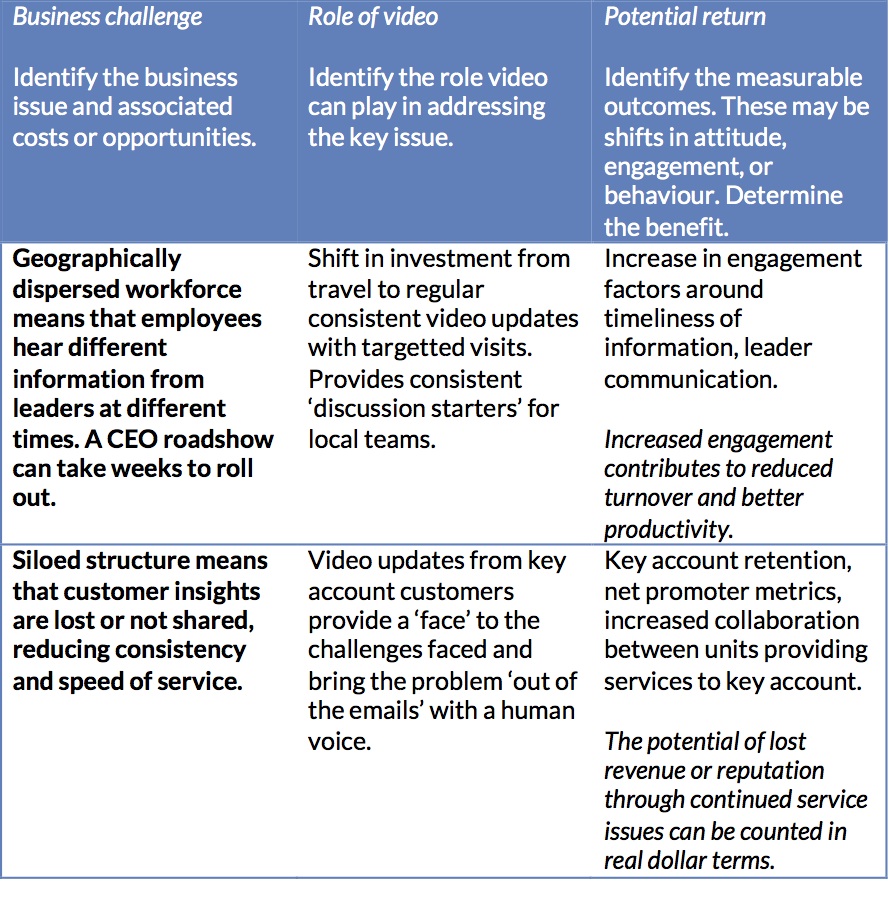
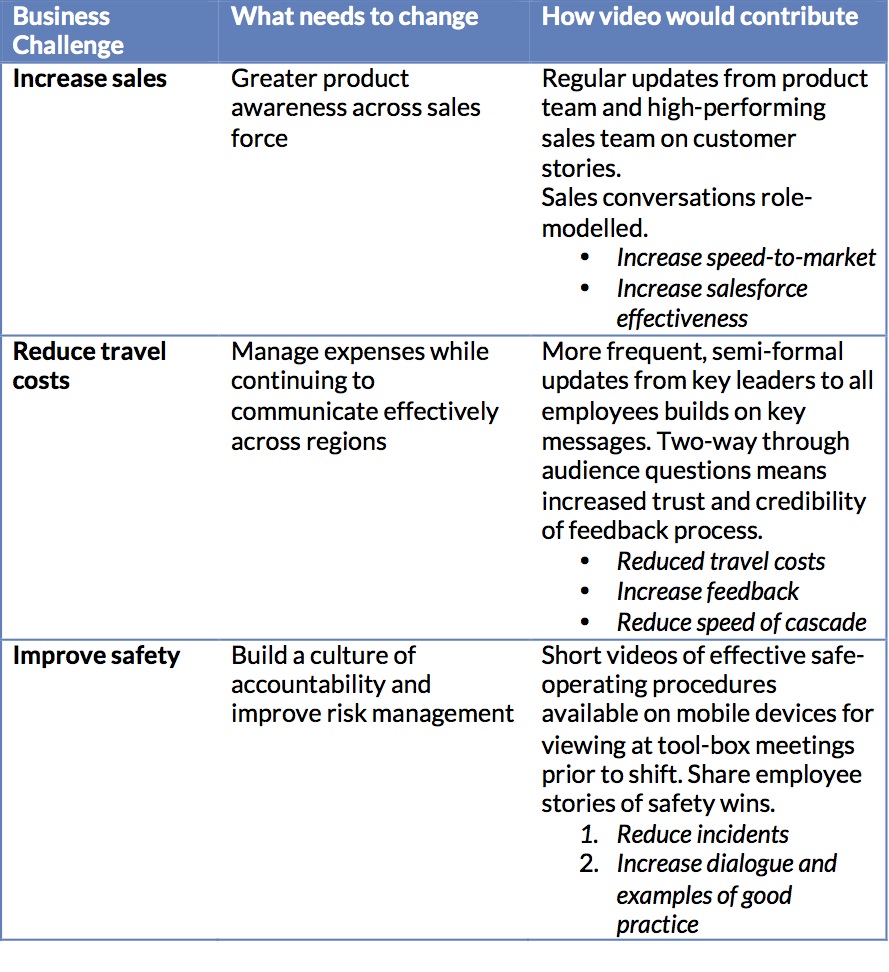
By clearly identifying the business outcome a communication activity is designed to solve, measurement becomes a simpler task. In each of the following examples, identifying the costs of the current state, and quantifying the outcomes provides a simple method of targeting benefits.

Potential Benefits

Potential Benefits

PROVE the case

What just happened? What changed as a result? How did people use the new approach?

Effective measurement is a perennial topic in communication. While top marketers are comfortable with demonstrating traffic, leads and conversions, internal communicators sometimes struggle with clearly demonstrating the return on initiatives.

However, if you have clearly identified the business outcomes, been clear about how video will help contribute to the solution, you are in a strong position to measure the impact.

Analytics packages allow for detailed viewing behaviour to be measured: who watched for how long, where and what did they use to watch, when did their attention shift. These data help shape the approach and provide essential information for looking at the impact of video content. Combined with audience feedback, this information will contribute to the evaluation of a pilot.


Prove the impact

Prove the impact

It’s a wrap – for now…

Video is an iterative channel. It grows and evolves with your overall business strategy. Great stories have a way of capturing people’s attention. If you find the right opportunity and take a strategic approach, people will take notice. You can transform a tactic – a broadcast, a leader message, an employee story – into a powerful strategic tool. Taking a planned approach to building the case and demonstrating the outcomes is the first step in making video an integral part of your engagement agenda and delivering valued outcomes to your business.


[1] Towers Watson 2013 – 2014 Change and Communication ROI Study Report http://www.towerswatson.com/en/Insights/IC-Types/Survey-Research-Results/2013/12/2013-2014-change-and-communication-roi-study


Special: Why this budget is an employee engagement nightmare and how leaders can make it better

An open letter to leaders and communicators in the Australian Public Service and Government Agencies

It may seem frivolous to talk about employee engagement while a razor hangs over 16000 to 25000 people’s jobs*.

There are around a quarter of a million people within the public service going to work today wondering what their future will be following the first Federal Budget to be delivered under the new Government. They will be wondering whether they are part of the “pain with a purpose” that the Budget is set to administer. If not them, their colleagues. If not their colleagues, those in another agency to be merged, subsumed or integrated.

Poor communication during change has a substantial negative impact on employee engagement and consequently on productivity, performance and culture. Uncertainty is crippling.

Every time an employee hears something fundamental about their role from outside their organisation, trust is destroyed. For workers in the public service or other agencies, where the debate about jobs, roles and size is played out in public, this is a difficult time (It is also one that occurs to a greater or lesser extent each budget or electoral cycle.)

“Our fatigue is often caused not by work, but by worry, frustration and resentment.” – Dale Carnegie

Disruption disrupts

Major change – transformational change such as redefining the scope and remit of an agency, or bringing together separate departments – in the short term creates a range of predictable responses and an accompanying downturn in productivity.

Study after study** about the negative impacts demonstrate that a number of conditions are a guarantee of reduced trust and disengagement:

  • Creating a high level of ambiguity by referencing major change without specific details
  • Publishing information externally on change that impacts individuals publicly before communicating directly with them
  • Providing no opportunities for input to change or its implementation
  • Not gathering feedback
  • Gathering feedback or research and not acknowledging the findings (even if the findings cannot be acted on it is key to be transparent)
  • Making ‘big bang’ announcements that are not supported with ongoing change and communication initiatives.

The news isn’t all bad

Significant change is an opportunity to maintain and increase engagement. The approaches to implementing major changes – even where it requires cuts – can provide a catalyst for the kinds of leadership and communication that build trust and strengthen the capacity for change. Towers Watson have shown how organisations that get this right see benefits in productivity, trust and capability.

It is possible to communicate in a way that is humanistic and respects employees. A study by Hewitt of change and engagement during the GFC indicated that in those companies where managers were able to explain the context of the tough decisions, engagement was retained or even increased.

A leaner public service will require higher levels of engagement to deliver ‘more with less.’ Yet, unless these changes are led effectively with meaningful employee communication, the support of the employees required to do the work will be eroded at exactly the time they will be needed the most.

In the UK, the recession, and the bite on business and government triggered the Macleod Report, an investigation into the value of employee engagement in the workplace.  Subsequently this has become a major government initiative to foster higher levels of employee engagement as an economic driver.

“As our public services face the reality of an end to the years of rapid growth in investment, it is hard to see how the quality of service we all aspire to see – employees and citizens alike – can be achieved without putting the enthusiasm, commitment and knowledge of public service employees at the forefront of delivery strategies.” David Macleod & Nita Clark

Four things public sector leaders can do now to maintain engagement

1. Make real communication a priority now

All the Ministerial Releases that can be printed or posted on the intranets (plural) will not actually address the communication need at the heart of this challenge.

During uncertainty people need more real communication, and they need it from their managers and supervisors fast. The majority of trust and engagement is attributable to the actions of leaders and supervisors, not memos.

Real means two-way face-to-face communication. Dialogue, listening, and discussion are part of the sense-making process for major change.  This requires planning, commitment, time and skills – at a time when costs are being scrutinised. But the cost of not adopting real communication is another workplace-generation of low engagement and mistrust.

2. Listen

This is what it says on the tin. There are two levels of listening that are key. The first is as a leader, genuinely listen; take time to hear and acknowledge the experience of people facing change. The second is institutional listening; ensure that there are ways of capturing the attitudes, questions and concerns of employees. In environments where listening has not been high on the agenda this is a big – but symbolically priceless – change if it is done effectively. This doesn’t mean ‘just another survey’ or feedback box. It does mean engaging in dialogue about the reality of the changes.

3. Stop waiting to communicate until there is more information

There will always be an information gap. That doesn’t mean there should be a communication gap.  Realise that not communicating is not an option.  Talk about possible scenarios, and talk to facts. Talk about process in the absence of details of the change. When there is nothing to update, tell people there is nothing to update. Ask questions.  Or listen.

If employees are reading something outside the organisation – whether in the news or on twitter – be prepared for some form of communication inside.

Making an announcement then asking employees to ‘discuss this with their manager’ without equipping managers and supervisors to have next-level conversations about change sets them up to fail. Even in organisations with healthy levels of engagement, it is not uncommon for there to be a pain point at the mid-level manager. They are expected to be the local face of change, yet are also typically facing the impact of changes themselves.  If it’s important to increase the focus on communication during uncertainty for employees, it is twice as essential for managers.

4. Be real

Communication is never a substitute for strategy. If the strategy is going to be challenging, saying otherwise is not going to make it better. Although the public is accustomed to spin being part of the political discourse, spin has no place in employee communication.

Discuss what the future requires, what the current situation looks like, and what needs to happen to bridge that divide. For managers and supervisors, this means taking the time to be able to understand change and discuss it.

If you don’t know, say you don’t know. Establish links to the policy and strategic priorities you do have greater certainty about.

The seven things to do next

  1. Have a plan
  2. Understand the context
  3. Put it in real language
  4. Prioritise face to face and dialogue
  5. Listen
  6. Support managers in their role
  7. Communicate some more.

As change and uncertainty is a feature of every industry and sector and part of the landscape of business – the new normal – rather than accepting the negative consequences, leaders have the opportunity to face into the change and use the change as a catalyst for open, constructive communication.


*The Commission of Audit has up to 25000 jobs to be cut depending on the recommendations applied.

** including Towers Watson, TJ Larkin, Hewitt, Edelman Trust, Melcrum

Disclosure: I have provided advisory counsel, change and communication training to a number of Federal and State Government departments, agencies and directorates, both as Meaning Business and in my former role as Research & Content Director, Melcrum Asia Pacific.