change

When to say no to Kotter-style change leadership

The Kotter model of change leadership is excellent for transformational change, but creates problems for communication in organisations when applied to mid-size change. In this extract from the recent webinar ‘The Art of Communication, the Business of Change‘ I explain why.

Audio courtesy of PRIA.

Story wars

Not everything is a story. But ‘story’ is the trend in terms of marketing and digital in particular.

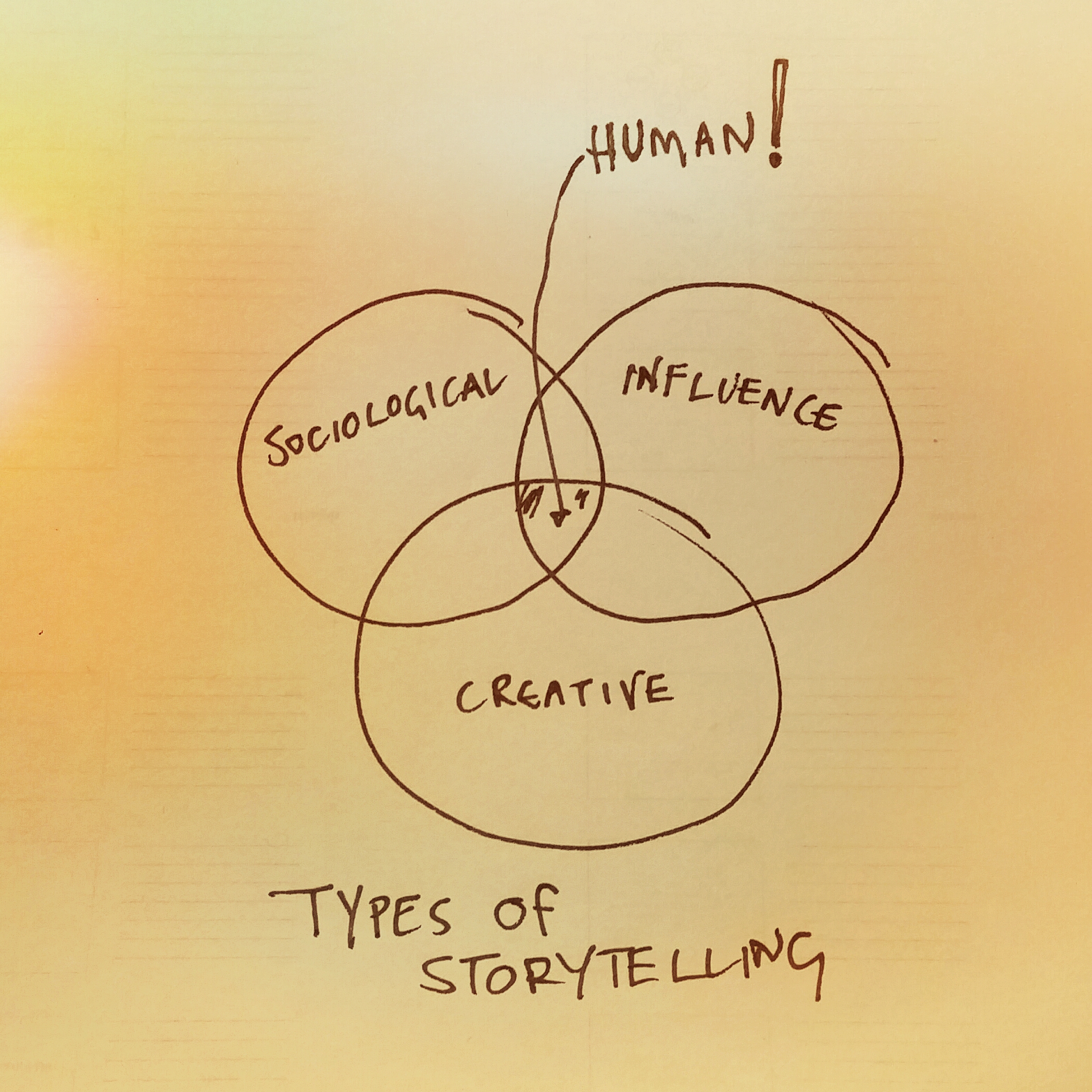
In organisations, there are a few camps in the story wars.

On one side we have the social scientists. In this group we have the behaviourists, the ethnographers, the anthropologists, who consider stories as a way of sense making, and of helping people create meaning (at work and beyond). The humanists. In the workplace, these are the change agents, the organisational psychologists, the culture practitioners.

On the other side we have the marketers. In this group we have the branders, the advertisers, the sales pitch creators. This group understands that stories told well create desires that can be met by products. The sellers. In the workplace, this is the sales and marketing team.

And then we have the creatives. Here are the people who have looked at the craft of story. The writers, illustrators, the performers. The tellers. These practitioners are not limited to one part of an organisation. A leader can be a natural at story performance. A researcher may be adept at finding the story within the data.

Types of storytelling

Daniel Pink tried to bridge these worlds in his book To Sell Is Human. He equates the process of storytelling with the need to create currency for ideas and in terms ‘trade’: we all try to persuade, every day. There is such mixed practice around what stories are and how they are used that frustrations sometimes boil over, as in this slightly NSFW argument by designer Stefan Sagmeister at a conference earlier this year.

Trevor Young, AKA the PR Warrior provides a pragmatic definition of organisational storytelling, the sweet spot between all the definitions in a recent post on this topic.

smart organisations look to storytelling as a way to gain a competitive advantage and use stories to help differentiate their brand in the marketplace; to be successful, these stories – and the perpetuation of them in the community in which they operate – need an organisation’s employees and partners to become involved. Essentially, it becomes a cultural thing.

Many communicators are caught between these worlds, and in the skirmishes. The challenge is to remember that in organisations we communicate for a purpose. Communicators have to find a path between these different forms of sense-making. They have to wear all of the ‘story’ hats and understand the difference between story sharing as culture, storytelling as motivation, and story as information.

Everyone IS a storyteller, because we are human. It is impossible for us not to tell stories. But there is a difference in kind between sharing stories around the contemporary campfire –  the dinner table, the water cooler, and sharing them in a public space (whether that space is real or virtual).


The changing world of change communication

Communication professionals are in the business of change. We design campaigns to understand perceptions and attitudes. At our best, we can contribute to shifting understanding, increasing awareness and influencing intentions.

Intent is key for internal communication. We communicate to create change.

Intent is key for internal communication. We communicate to create change.

And yet, when it comes to the processes of managing change within organisations, the world of communication and the world of change can seem like different planets.

Short-term versus long term

PR – particularly when not in-house- is frequently a short-cycle activity. Communicators get in, understand a problem, an issue or a stance, manage our campaign, and then get out again.

Three years ago, I was facilitating a discussion with communication professionals about the differences between internal communication and external communication, and why specialists in the two fields don’t always see eye to eye. One very experienced practioner summed up the challenge well. At the risk of making broad generalisations, he indicated that external comms practitioners are adept at short cycle communication, deep diving into an issue as required, working with the news cycle and then moving on to the next issue. By contrast, he felt that internal communicators may be used to longer time scales for achieving changes in culture or engagement, looking holistically at the interdependencies and ongoing employee experience.

Historically that may have been correct, but communicators need to be agile when communicating change internally and externally. This means being adaptable and responsive to circumstances that may be constantly evolving. It requires communicators to be active agents of change.

Change agents and Change Agents

Organisational development and transformational change, process change, operational change management: each are different varieties of change that rely on different communication methods and approaches.

There is more to managing (most types of) change than communication alone. Understanding the key steps in the change management process, the different types of organisational change, and the key roles for leadership, communication, training and even HR, helps create the partnerships that lead to effective change.

We explored these ideas and more in the  PRIA webinar, The Business of Change, The Art of Communication on 14 November. PRIA members will ion be able to access the webinar recording, and the slideshare is available.

In the session, we defined and aligned approaches to change communication for in-house practitioners working on major projects, PR and comms professionals who are part of an agency response to change, or even managing changes in your own business.

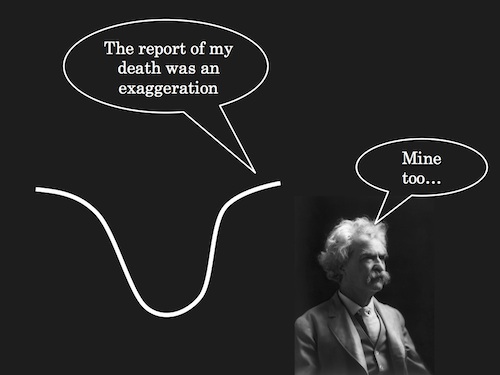
Rumours of the change curve’s death are exaggerated

The change curve isn’t quite dead yet.


In their new study, The Agile IC Function, Melcrum have looked at how organisational complexity has changed the demands on managing the IC function. In outlining the research, Melcrum point to three ‘foundation beliefs’ about communication that are ready for disruption.

It is exciting work, providing real benefits for comms leaders looking for new approaches to manage in workplaces that are changing constantly.

The study points to the non-linear nature of transformation, and proposes that the curve has outlived its usefulness do to the degree of concurrent change within organisations. Here I am taking on the change curve’s right of reply. I would argue that it the change curve is the only model comms and leadership use for managing change, they are doing it wrong.

Models out of context are lines on a page

So many models in communication get applied to the wrong thing, and then practitioners are surprised when the result wasn’t what was intended. This particularly applies to applying linear approaches to complex interactions.

One of the most famous misuses of a communication model is that of the Shannon-Weaver ‘communication model.’ This linear model that shows the flow of ‘messages’ being diluted by ‘noise’ is still embedded in many resources about communication.

Here’s the problem. This model was designed to describe how data is diluted as electrical signals move through circuits. The context for the model had nothing to do with human communication*.
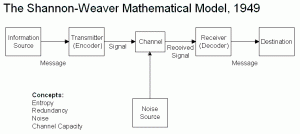
Shannon-Weaver's communication model has little to do with human communication

Shannon-Weaver’s communication model has little to do with human communication

But it is a compelling diagram. So much so that it has been taught as a model of communication in business schools, leadership training, and is in the top search results in response to the question ‘How does communication work.’

The problem isn’t with the model; it is with how it is used.

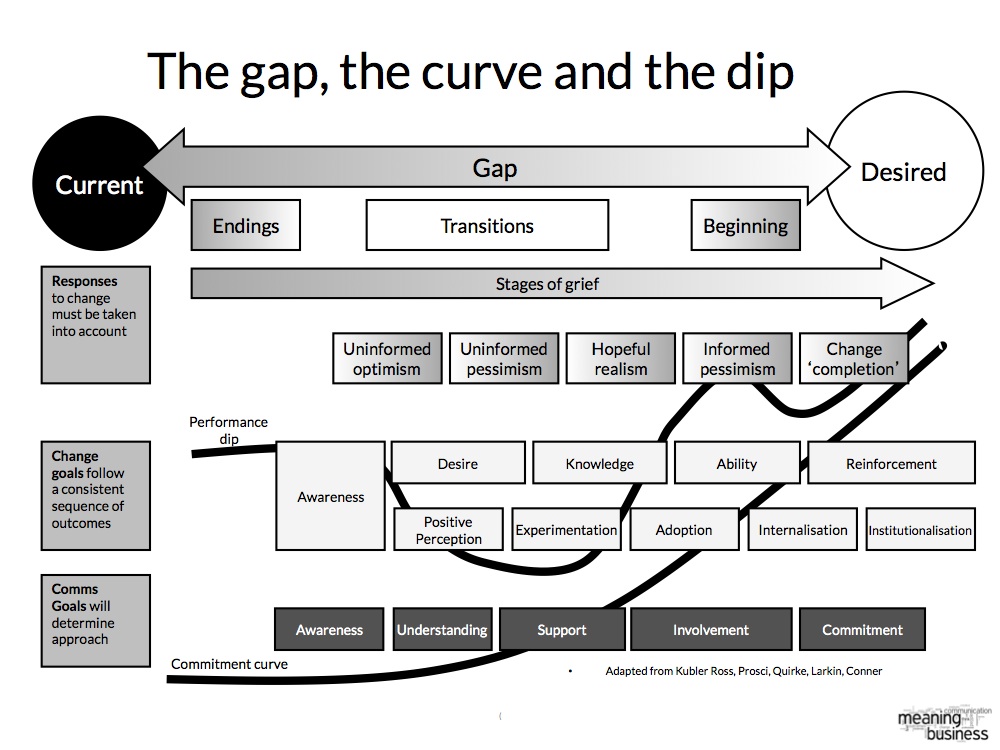
Let’s go back to the origin of the change curve: it was an interpretation of the work of Elisabeth Kubler Ross in her book On Death And Dying to look at how people move through bereavement in five typical stages.

 Denial | Anger | Bargaining | Depression | Acceptance

 It was then and remains a heuristic model for viewing human experience.

Organisational change practitioners in the 1970s and 1980s soon understood that there were parallels at work. Organisational change is a process of managing loss. Resistance to change is a form of loss aversion: loss of job, loss of status, and loss of certainty.
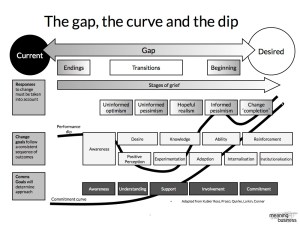
Many change models derive from the theory of loss

Many change models derive from the theory of loss

Download the PDF of all the models

Any leaders who has had to conduct layoffs face to face with employees, or who has had to manage a major relocation, or change a structure, or communicate that there will be no bonuses this year will have seen how accurate the change curve is in describing the individual response to change.

The challenge, as identified in the new Melcrum study, is that this response doesn’t ‘scale up’ very well. The individual experience of change can be understood, but how do you design change communication for people going through multiple iterations with no beginning and no end?

Babies and bathwater, and a little irony

Models are ways for us to understand behaviours and systems. They are a proxy for the real experience of the organisation. Understanding the balance between the context for the model and its pragmatic application is essential in order to navigate the world of work. Complexity in organisations means that few linear models will work in isolation. There are seldom the ‘simple answers’ practitioners crave.

Melcrum’s new study raises very important questions for IC leaders and encourages them to think smarter about how to deliver services in a changing workplace. Leaders do need to work with new models and approaches for this new environment.

This means challenging lots of assumptions and existing processes as they ask leaders and partners to change their understanding of what contemporary IC practice is. And that’s going to provoke anger and denial in some practitioners before they accept it and commit to working in new ways.

As they introduce new ways of working, IC leaders can expect to face resistance from the ExCo to doing things in new ways. Or their HR Director may not initially be supportive of changes to the structure to be more adaptive. And the manager in the business area who is used to embedded communication support will almost certainly resist having resources taken away.

And this is exactly where the understanding (rather than the rigid application) of the change curve will remain useful. Maybe there is some life in the old curve yet.

The change curve still has some life in it yet.

The change curve still has some life in it yet.

*For an excellent description of the birth of the Shannon-Weaver model, I recommend James Gleick’s The Information.

Disclosure: From 2012-13 I was Research & Content Director, Asia Pacific for Melcrum. These views are my own.